

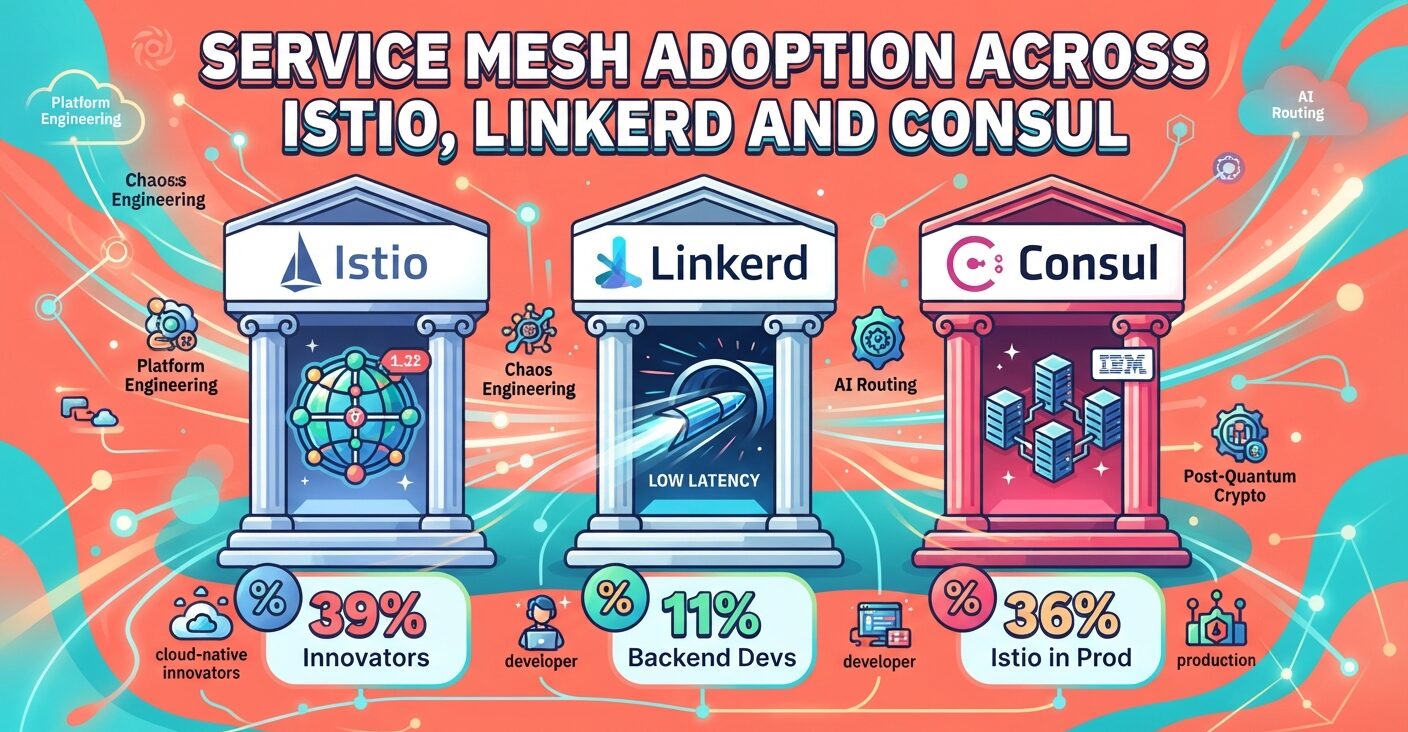
Two published figures frame service mesh adoption right now. SlashData’s Q1 2026 survey for CNCF found 11% of backend developers used a service mesh, while CNCF’s September 2025 survey found 36% of organizations running Istio in production.
This brief covers both measures, the platform engineering effect on developer counts, the practices that travel with meshes, and the 2025-2026 release and support record for Istio, Linkerd and Consul.
Service Mesh Adoption: 2026 Snapshot
How Many Developers Use a Service Mesh in 2026?
Service meshes were used by 11% of backend developers in Q1 2026, up from 8% in Q3 2025. The data comes from SlashData’s online Developer Nation survey for CNCF, weighted by SlashData and fielded December 2025 to January 2026 (n=2,792 backend developers).
SlashData reports that most tracked technologies dipped slightly over those six months, and service meshes were the exception. The firm adds that the 11% still sits below the high recorded before its 2025 change to the backend developer definition.
API gateways (47%) and microservices (39%) top the list, with Kubernetes at 27%. Organization-level surveys put Kubernetes far higher, as these Kubernetes and container adoption numbers show.
Source: CNCF and SlashData, State of Cloud Native Development Q1 2026 (backend developers, multi-select, Q1 2026)
Does Platform Engineering Hide Service Mesh Use?
Infrastructure standardization reached 88% of backend developers in Q1 2026, up from 80% six months earlier. The share with no formal platform or DevOps practice fell from 20% to 12%.
SlashData suggests developers who deploy through internal platforms may not report the containers, Kubernetes or meshes underneath. The report presents this as a measurement question and says causation cannot be established.
The CI/CD layer those platforms run on is tracked separately in our DevOps and pipeline adoption statistics.
Source: CNCF and SlashData, State of Cloud Native Development Q1 2026 (Q3 2025 vs Q1 2026)
Istio at 36%: Organization-Level Service Mesh Adoption
CNCF’s 2025 Annual Survey asked which graduated projects organizations use in production. Istio reached 36% and Envoy 33%, while Kubernetes, Helm and etcd landed between 81% and 87%.
Bases range from 395 to 596 respondents per project because “don’t know” replies were excluded. These are organization shares from a 628-respondent survey, so they do not line up with SlashData’s developer share.
The same question covers runtimes: containerd at 74% and cri-o at 34%, compared in our containerd vs CRI-O vs Docker breakdown.
Source: CNCF Annual Cloud Native Survey, Q32, fielded September 2025 (+/- 3.3% margin of error at 90% confidence)
Service Mesh Use by Cloud Native Maturity
CNCF classes 25% of organizations as innovators, meaning they use cloud native for nearly all development. Innovators are almost three times as likely as explorers to run a service mesh in production.
Container challenges in the same survey were led by cultural change with the development team (47%), lack of training (36%) and security (36%).
Source: CNCF Annual Cloud Native Survey, 2025 (maturity segments n=380; container challenges n=351)
What Technologies Travel With Service Mesh Adoption?
SlashData measures co-usage with lift. A lift of 1.0 means two technologies appear together at the rate chance predicts, and 1.7 or higher counts as a strong association.
Across all backend developers, service meshes pair most with chaos engineering (1.76) and immutable infrastructure practices (1.75). The Kubernetes lift is 1.04, close to chance.
Two pairings fall below 1.0: microservices at 0.87 and API gateways at 0.77. Service mesh users report these less often than chance predicts.
AI developers show sharper ties, with chaos engineering at 2.36 and immutable infrastructure at 2.07. SlashData groups service meshes, chaos engineering and multicluster management as the advanced end of the AI maturity path.
Source: CNCF and SlashData, State of Cloud Native Development Q1 2026 (backend developers n=2,792; AI developers n=1,270)
Eight Istio Minor Releases Since March 2025
Istio shipped 1.25 on March 3, 2025 and 1.32 on November 9, 2026. Each minor line is supported until six weeks after the release two versions later.
| Version | Release date | End of life | Supported Kubernetes |
|---|---|---|---|
| 1.32 | Nov 9, 2026 | ~Jun 2027 (expected) | 1.33-1.37 |
| 1.31 | Aug 27, 2026 | ~Mar 2027 (expected) | 1.32-1.37 |
| 1.30 | May 14, 2026 | ~Dec 16, 2026 (expected) | 1.32-1.36 |
| 1.29 | Feb 16, 2026 | Oct 15, 2026 | 1.31-1.35 |
| 1.28 | Nov 5, 2025 | Jul 1, 2026 | 1.30-1.34 |
| 1.27 | Aug 11, 2025 | Apr 7, 2026 | 1.29-1.33 |
Source: Istio, Supported Releases page, checked November 2026
The release table dates 1.30 to May 14, 2026. Istio’s 1.28 end-of-life notice gives May 18, 2026.
Ambient Multicluster and AI Routing
On March 25, 2026, CNCF announced ambient multicluster and the Gateway API Inference Extension as beta, plus experimental agentgateway support in Istio’s data plane.
Istio 1.32 lets one east-west gateway carry both ambient and sidecar multi-network traffic. It also adds utilization-based load balancing driven by backend load reports.
Source: CNCF announcement, March 25, 2026; Istio 1.32 release announcement, November 9, 2026
Linkerd vs Istio Ambient: The 2025 Latency Benchmark
Linkerd’s April 2025 benchmark drove the emojivoto app with wrk2 on a three-node GKE cluster of e2-standard-8 machines. It used 100 connections at 20, 200 and 2,000 RPS, with five runs per level and the two worst discarded.
| Load | p99 comparison | Gap |
|---|---|---|
| 200 RPS | Istio sidecar vs Linkerd | 22.83 ms higher |
| 200 RPS | Istio sidecar vs no-mesh baseline | 19.9 ms higher |
| 200 RPS | Istio sidecar vs Istio ambient | 18.5 ms higher |
| 2,000 RPS | Istio sidecar vs Linkerd | 163 ms higher |
| 2,000 RPS | Istio ambient vs Linkerd | 11.2 ms higher |
Source: Linkerd, “Linkerd vs Ambient Mesh: 2025 Benchmarks,” April 24, 2025
Ambient ran with a waypoint proxy for L7 processing to match Linkerd’s feature set. Buoyant notes a Linkerd Ambassador ran the test on north-south traffic, so it is not vendor-neutral.
Linkerd 2.19 and 2.20
Linkerd 2.19 shipped October 31, 2025 with ML-KEM-768 post-quantum key exchange on by default between meshed pods. Version 2.20 followed on June 23, 2026 and made native sidecars the default for proxy injection.
Buoyant’s 2.20 release notes cite destination controller memory cuts of up to 84% in load testing, which the Linkerd announcement rounds to almost 85%. Kubernetes 1.35 is the new maximum supported version.
Source: Linkerd release announcements, October 2025 and June 2026; Buoyant Enterprise for Linkerd 2.20 release notes
Consul Service Mesh Adoption After IBM’s Support Change
IBM closed its HashiCorp acquisition on February 27, 2025 at $35 per share, an enterprise value of $6.4 billion. From the April 2026 2.x release, Consul Enterprise follows IBM Support Cycle-2: two years base, one year critical extended and three years sustained support.
| Consul version | Planned end of support | IBM Extended Support ends | IBM Ongoing Extended Support ends |
|---|---|---|---|
| 2.0.x | April 30, 2028 | April 30, 2029 | April 30, 2032 |
| 1.21.x (LTS) | April 30, 2027 | n/a | n/a |
| 1.22.x | October 31, 2026 | n/a | n/a |
| 1.18.x (LTS) | April 30, 2026 | n/a | n/a |
Source: HashiCorp, Consul 2.0.x release notes, 2026
Consul 1.22.x reached end of support on October 31, 2026, six months before the older 1.21.x LTS line. Both IBM extended tiers are optional paid packages.
Consul 2.1.0 Adds Hybrid Post-Quantum Key Exchange
Consul 2.1.0, released in October 2026, supports configurable X25519MLKEM768 hybrid TLS key exchange. HashiCorp states this does not make certificate signatures post-quantum.
The release moves transparent proxy redirection from iptables to nftables. It also adds a beta Agentic Runtime Fabric for AI workloads in the Enterprise edition.
Source: HashiCorp, Consul 2.1.0 announcement and release notes, October 2026
Hybrid Deployment Context
Hybrid cloud deployment reached 34% of all developers in Q1 2026, the highest share SlashData has recorded, and 26% of backend developers. Provider-level OS figures sit in our cloud provider Linux usage breakdown.
Public cloud deployment among backend developers fell from 33% to 30% over the same six months. Provider revenue shares are covered in this AWS vs Azure vs GCP comparison.
Source: CNCF and SlashData, State of Cloud Native Development Q1 2026
FAQs
What percentage of developers use a service mesh?
11% of backend developers used a service mesh in Q1 2026, up from 8% in Q3 2025, based on SlashData’s survey for CNCF of 2,792 backend developers.
How many companies use Istio in production?
36% of organizations reported running Istio in production in CNCF’s 2025 Annual Survey, fielded September 2025. Envoy, the proxy Istio’s data plane is built on, scored 33% on the same question.
Is Linkerd faster than Istio ambient mode?
Linkerd’s April 2025 benchmark measured its p99 latency 11.2 ms below Istio ambient at 2,000 RPS. The Linkerd project published the test, so it is not an independent result.
Do Reddit threads on service meshes reflect real adoption?
No. Reddit threads are anecdotal and unweighted. Measured data puts service mesh use at 11% of backend developers (Q1 2026) and Istio production use at 36% of organizations (September 2025).
When did Consul 1.22 support end?
Support for Consul 1.22.x ended on October 31, 2026. The 1.21.x LTS line runs to April 30, 2027, and 2.0.x to April 30, 2028.
