

According to the 2025 XDS Insights Report, 70% of publishers now spend over $6 million a year on external development, and that figure reflects a broader shift in how studios think about building games without doing everything in-house.
The decision most buyers face early is not whether to bring in outside help, but what form that help should take: a freelance video game developer hired directly, or a game outsourcing company structured around full production teams.
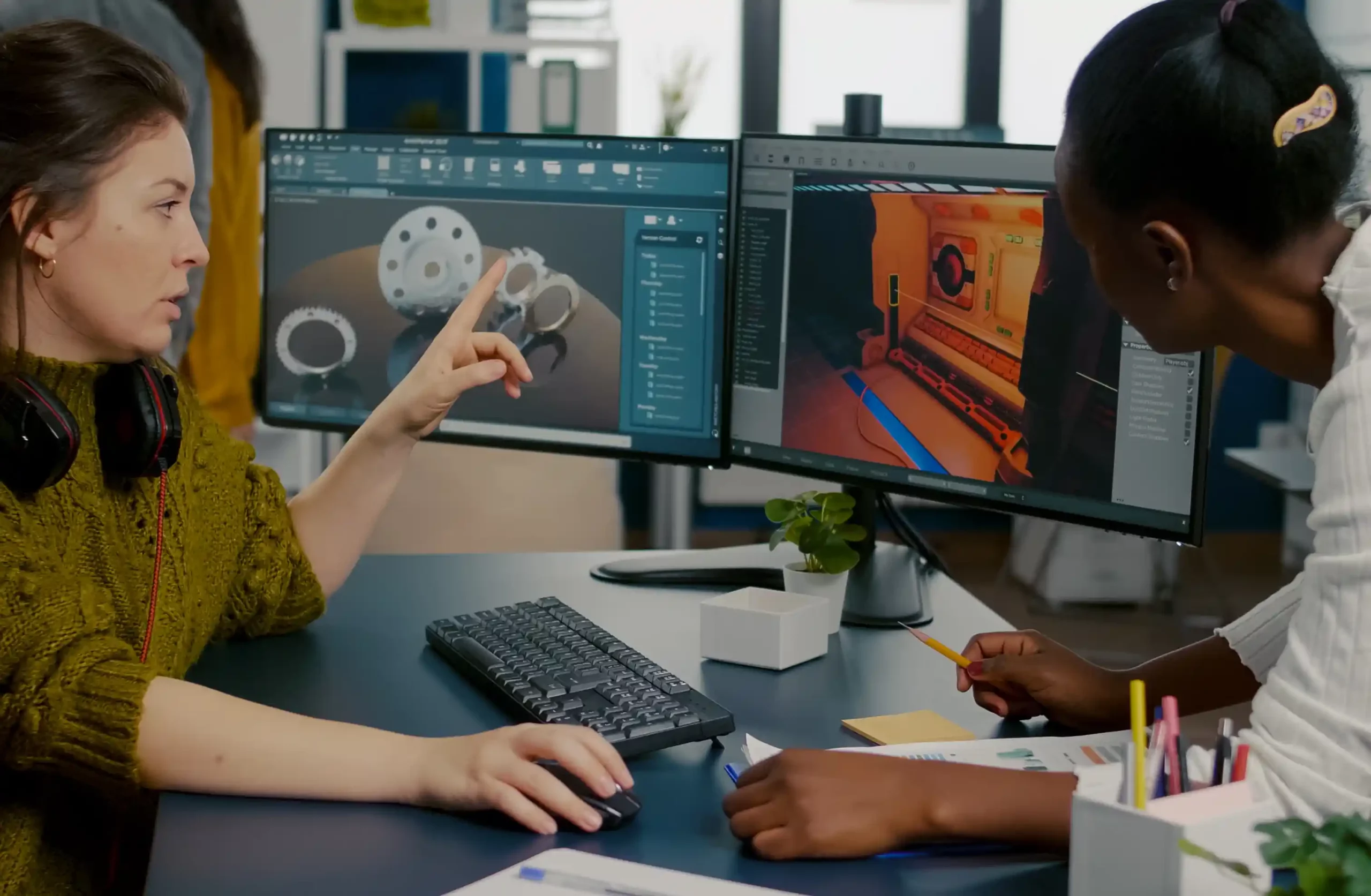
These are not interchangeable choices dressed up differently. They solve different problems, carry different risks, and suit different kinds of projects.
Understanding which one fits a given situation prevents a mismatch that becomes expensive to correct mid-production.
What Freelance Game Developers Are Actually Good For?
Freelance game developers excel at contained, well-defined tasks where the scope is clear and the work does not require deep coordination with other disciplines.
A single environment artist, a UI designer, or a specialist animator can often be engaged quickly and cost-effectively for a specific deliverable.
Freelancers offer cost-effective short-term support for specific tasks like concept art, modeling, or level design, with rates varying by skill level from a few hundred dollars per asset to premium rates for senior developers.
This makes freelance arrangements a sensible fit for narrow, task-based needs that don’t require ongoing production management.
Where freelance game developers tend to work well:
- A single batch of concept art or marketing assets with a defined brief
- A short, isolated coding task that doesn’t touch core systems
- Supplementing an existing in-house team during a temporary capacity gap
- Early prototyping work where iteration speed matters more than polish
Where the Freelance Model Starts to Strain?
The challenges with freelance video game developers rarely show up on the first task. They surface when the project scales, requires coordination across disciplines, or needs to run reliably over months rather than weeks.
Production Planning Becomes the Buyer’s Job
Freelancers generally focus on execution. Production planning, task breakdown, milestone tracking, and coordination often remain the client’s responsibility, which requires internal producer capacity that many buyers do not have.
This is the single most underestimated cost of the freelance model: someone still has to manage the project, and that someone is usually the client.
Availability and Continuity Are Not Guaranteed
Freelancers typically balance multiple clients, so availability can fluctuate, and unexpected interruptions like illness or scheduling conflicts may impact timelines.
A single freelancer represents a single point of failure. If they become unavailable mid-project, the work stops until a replacement is found and brought up to speed.
Consistency Erodes Across Multiple Contributors
When hiring multiple freelancers across disciplines, maintaining stylistic and technical consistency requires careful monitoring, and one individual can only deliver a finite volume of work, so scaling output means onboarding additional freelancers, which increases coordination complexity.
Every new freelancer added to cover capacity introduces another voice that needs to be aligned with the project’s existing style and standards.
Worth noting: If a freelancer leaves a project, their learned context and workflow knowledge, such as how they created specific textures or solved a particular technical problem, often leaves with them. That institutional knowledge rarely transfers cleanly to whoever picks up the work next.
What a Game Outsourcing Company Provides Instead?
Game outsourcing companies often provide multi-disciplinary support under one banner, which changes the coordination burden significantly.
Rather than managing several independent freelancers, the buyer works with a single point of contact who is responsible for coordinating the team internally.
| Factor | Freelance Developers | Game Outsourcing Company |
| Production planning | Buyer’s responsibility | Handled by the studio’s producers |
| Continuity if someone leaves | Knowledge often lost | Retained within the team |
| Coordination across disciplines | Buyer manages multiple contacts | Single point of contact |
| Scaling output | Requires onboarding more freelancers | Existing team absorbs more capacity |
| Consistency across deliverables | Requires active monitoring | Built into shared internal process |
One studio simplifies coordination and communication, since everything flows through a single point of contact, while multiple specialists might deliver higher quality in specific, narrow areas but require more management overhead to coordinate between them. This tradeoff is the core decision buyers are actually making.
The Real Reason Studios Choose One Model Over the Other
The decision is rarely about quality alone. Coordination overhead and weak production governance are what cause outsourced engagements to break down, not a lack of vendor capability.
A talented freelance developer and a competent outsourcing studio can both deliver good work. What differs is who absorbs the coordination risk when a project grows beyond a single contained task.
Questions that clarify which model fits a specific project:
- Does the work require coordination across multiple disciplines, like art, engineering, and QA, simultaneously?
- Is there internal producer capacity to manage freelancers directly, or does that responsibility need to sit with the partner?
- Does the project need to scale up or down significantly over its timeline?
- How costly would it be if a single contributor became unavailable mid-project?
A narrow, well-scoped task with low coordination needs tends to favor freelance video game developers. A project with interdependent systems, a longer timeline, or significant scaling needs tends to favor a structured outsourcing studio.
Hybrid Approaches Are Common in Practice
Many studios do not choose one model exclusively. A hybrid model that outsources specialized tasks like cinematic animation or VFX to a studio while using freelancers for smaller, isolated deliverables maintains creative control while scaling resources flexibly as the project evolves.
For first-cycle full game development projects in particular, the core production typically benefits from the coordination a studio provides, while specific isolated tasks can still go to freelancers without disrupting the main pipeline.
This is not an indecisive middle ground. It is a deliberate allocation: tasks that are genuinely contained go to freelancers, while anything that touches multiple systems or needs sustained coordination goes to a partner equipped to manage that complexity.

What to Verify Before Committing Either Way?
Whichever direction a buyer leans, a few due diligence steps apply regardless of which model is chosen.
- Request and check references from past clients, not just a portfolio
- Confirm in writing how IP ownership transfers upon completion and payment
- Clarify how scope changes will be priced and approved before work begins
- Ask specifically how continuity is handled if a contributor becomes unavailable
For projects with more complex production needs, the video game development stages from idea to release outline where coordination demands are highest, which is often the clearest signal for whether a project needs the structure a game outsourcing company provides rather than a collection of independent freelancers.
FAQs
Is hiring freelance game developers always cheaper than an outsourcing studio?
On a per-hour or per-asset basis, often yes. But the comparison changes once internal production management time is factored in, since freelance arrangements typically require the buyer to handle coordination, milestone tracking, and consistency monitoring that a studio absorbs as part of its service.
Can freelancers handle a full game development project on their own?
It is possible for very small, simple projects, but it becomes increasingly difficult as scope grows. Coordinating multiple freelancers across art, programming, and QA without a unifying production structure introduces the kind of consistency and continuity risk that scales poorly with project complexity.
What happens to a project if a key freelancer becomes unavailable?
Work typically stalls until a replacement is found, vetted, and brought up to speed on the existing work. Any undocumented decisions or techniques the original freelancer used may need to be reverse-engineered or redone, which is a common source of delay in freelance-heavy projects.
Is a game outsourcing company a better fit for a first-time buyer with no production experience?
Generally yes. A buyer without internal producer capacity benefits from a studio’s existing project management structure, since freelance arrangements assume the client can handle coordination, task breakdown, and milestone tracking themselves.
How do I know if my project needs a studio rather than freelancers?
The clearest signal is interdependency. If different parts of the project, art, code, audio, depend closely on each other and changes in one area affect the others, a coordinated team structure reduces the risk of inconsistency far more reliably than independently managed freelancers.
Do outsourcing studios cost significantly more than freelancers for the same work?
Pricing varies, but the studio’s rate typically includes production management, quality oversight, and team continuity that a freelancer’s rate does not. The more accurate comparison is total project cost, including the buyer’s own time spent coordinating, rather than a simple hourly rate comparison.
