

Visual content production represents one of the largest operational expenses in e-commerce, yet the return on that investment is undeniable. Professional product imagery drives click-through rates, builds purchase confidence, and reduces returns caused by mismatched expectations.
The challenge for most online sellers is not recognizing this value but producing professional visuals at the scale their catalogs demand without exhausting their budgets.
As AI image generation matures into commercially viable territory, the economics of e-commerce visual production are undergoing a structural shift that favors agile operators willing to rethink their creative workflows.
AI Image Generation as Commercial Visual Infrastructure
E-commerce visual requirements have expanded far beyond simple product photography.
A competitive listing now demands multiple image types: clean studio shots for marketplace compliance, lifestyle context images that help shoppers visualize ownership, detail close-ups that substitute for physical inspection, and promotional graphics optimized for advertising placements.
Each image type serves a distinct commercial function, and each requires specific production considerations.
The maturation of AI image generation into commercially reliable territory changes this competitive equation fundamentally. Rather than treating each product image as a discrete production project, sellers can generate professional-grade visuals from product specifications and reference materials at costs that make comprehensive catalog coverage economically accessible.

Pollo AI’s GPT Image 2.5 AI Image Generator delivers the specific visual qualities that commercial product imagery demands. The model renders material surfaces with physical accuracy—metal finishes exhibit realistic reflective properties, fabric textures display authentic weave patterns, and transparent materials show appropriate light refraction.
For e-commerce applications where product imagery directly influences purchase decisions and return rates, this material fidelity is not aesthetic luxury but commercial necessity.
The generation speed advantage translates directly into operational efficiency for catalog-scale production. Processing that previously required days of studio time and editing compresses into hours of AI-assisted generation, freeing operational resources for other growth activities.
For sellers launching new product lines or entering seasonal promotional cycles, this acceleration can mean the difference between launching on schedule and missing critical sales windows.
The zone-based editing capability proves especially valuable in e-commerce iteration workflows. When marketplace compliance requires background modifications, when A/B testing demands color temperature variations, or when seasonal campaigns need contextual setting changes, sellers can modify specific image regions while keeping product rendering untouched.
This precision eliminates the risk of inadvertently altering product appearance during editing—a concern that has historically made iterative visual optimization risky for product listings.
Building Scalable Visual Operations
Implementing AI image generation across an e-commerce operation requires systematic integration with existing catalog management processes.
Establishing Category Visual Standards
Define clear visual specifications for each product category: lighting direction, background treatment, shadow style, and color temperature. Electronics benefit from crisp directional lighting. Textiles require warm diffusion.
Beauty products demand neutral, color-accurate rendering. Document these specifications as reusable generation templates that ensure visual coherence across all products within each category.
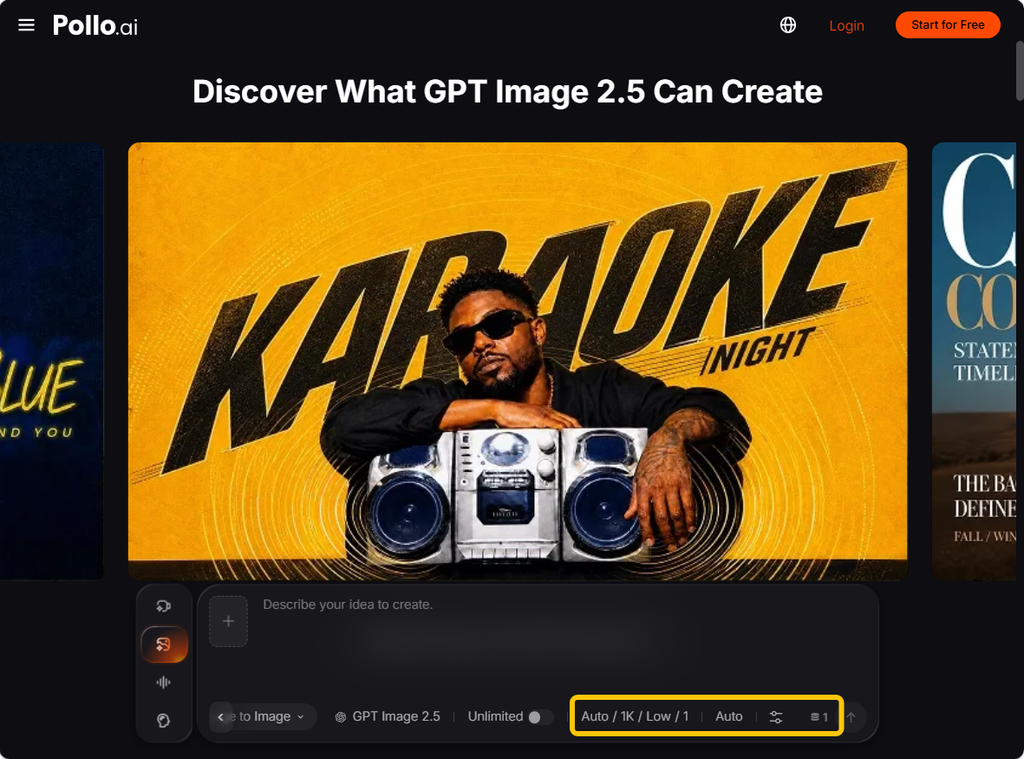
Pollo AI’s GPT Image 2.5 AI Image Generator supports multiple aspect ratios and resolution tiers from 1K to 4K, accommodating everything from marketplace thumbnail requirements to high-resolution zoom functionality and print catalog applications within a single generation workflow.
Batch Generation and Quality Control
Process product images in category-aligned batches to maintain visual consistency across related listings. Generate the full image set for each product—hero shot, alternate angles, detail views, and lifestyle compositions—in a single session.
Review generated output for color fidelity, proportion accuracy, and material authenticity before deployment.
For brands requiring integration with existing content management systems or automated catalog workflows, the platform’s API access enables developers to build custom generation pipelines that connect directly to product databases, triggering visual asset creation automatically as new products enter the catalog.
Iterative Optimization Based on Performance Data
Deploy generated visuals with proper tracking to measure their commercial impact. Monitor click-through rates, conversion metrics, and return rate changes at the individual listing level. Use performance data to refine your generation parameters—identifying which visual treatments drive the strongest commercial outcomes for each product category.
Pollo AI’s GPT Image 2.5 AI Image Generator’s regional editing capability supports this data-driven optimization. When performance data suggests that a warmer background tone or different contextual setting would improve conversion, sellers can modify specific image elements without regenerating entire compositions, testing visual hypotheses efficiently.
Extending Product Images Into Promotional Video
Static product imagery, however polished, addresses only part of the content spectrum that modern e-commerce demands. Marketplace algorithms increasingly favor video content, and social commerce platforms require dynamic product presentations that static images cannot provide.

Pollo AI’s AI photo to video ad generator creates a natural content extension from generated product imagery.
Sellers can transform their AI-created product visuals into short promotional clips featuring natural product motion, realistic depth effects, and multilingual voiceover options—all generated automatically from the source image without requiring separate video production resources.
The tool outputs content pre-formatted for major social and marketplace platforms, eliminating the manual reformatting that typically adds hours to multi-channel content deployment.
For e-commerce operations running continuous advertising campaigns across multiple platforms, this image-to-video capability means that every product image generated through GPT Image 2.5 AI Image Generator on Pollo AI can serve as source material for both static listings and dynamic advertising placements.
A single creative investment produces assets for the full content spectrum.
The practical value intensifies during high-velocity commercial periods—product launches, seasonal promotions, flash sales—when both static and video content must be produced under compressed timelines.
Pollo AI’s AI photo to video ad generator enables sellers to generate promotional video content from freshly created product imagery within minutes, ensuring that video advertising launches simultaneously with static listing updates rather than trailing days or weeks behind.
The API Advantage for Scaled Operations
For larger e-commerce operations and technology-forward brands, the availability of API access introduces automation possibilities that transform visual production from a manual workflow into a programmatic capability.
Development teams can build custom integrations that trigger image generation automatically when new products are added to inventory management systems. Seasonal visual refreshes can be programmed to execute across entire product categories based on predefined templates and schedules.
Multi-marketplace format adaptation can be automated to produce platform-compliant variations from a single master generation.
This programmatic approach to visual production represents a structural competitive advantage for operations willing to invest in integration.
The per-image cost approaches negligibility at scale, making comprehensive visual coverage—including multiple image types per product, seasonal variations, and platform-specific adaptations—economically trivial compared to traditional production methods.
Conclusion
The competitive dynamics of e-commerce visual content are shifting from production budget to visual strategy.
When professional-grade product imagery becomes accessible through tools like Pollo AI’s GPT Image 2.5 AI Image Generator, the advantage belongs to sellers who deploy visual content most strategically rather than those who simply spend the most producing it.
For e-commerce operations ready to build scalable, data-driven visual production systems, the infrastructure now exists to compete on image quality at any catalog scale.
