

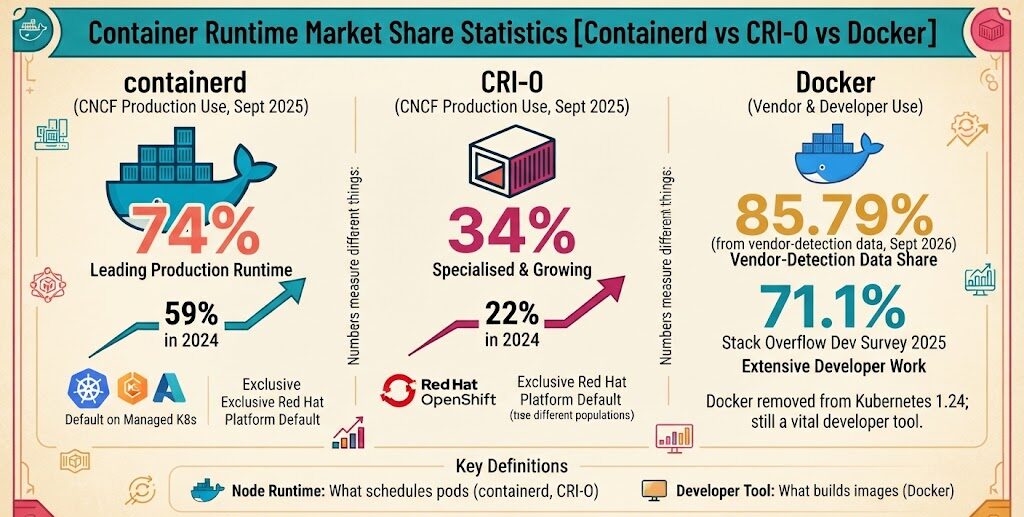
Containerd reached 74% production use among CNCF survey respondents in September 2025, against 34% for CRI-O. Docker, meanwhile, holds 85.79% of a vendor-detection dataset covering 196,059 companies. Those numbers describe different things, and the gap between them is the point. This post sets out what each container runtime dataset actually counts.
Container Runtime Market Share: Key Figures
containerd vs CRI-O: Container Runtime Market Share in Production
The CNCF Annual Cloud Native Survey asks respondents whether their organization uses each graduated project in production or is evaluating it. Both runtimes moved up between editions.
containerd gained 15 points and CRI-O gained 12. The two figures come from separate question rows with their own bases, so they cannot be added together into a combined share.
The 2025 edition surveyed 628 respondents and reports a margin of error of plus or minus 3.3% at 90% confidence. The 2024 edition surveyed 689 and reports plus or minus 3.2%.
| Runtime | In production, 2024 | In production, 2025 |
|---|---|---|
| containerd | 59% | 74% |
| CRI-O | 22% | 34% |
Source: CNCF Annual Cloud Native Survey, Q32, fielded November–December 2024 (689 respondents) and September 2025 (628 respondents, Q32 sample 395–596)
containerd’s evaluating share sat at 7% in 2025, the profile of a project whose pipeline has already emptied into production. CNCF puts Kubernetes, Helm and etcd together in an 81–87% band and does not break those three out individually.
Where containerd ranks among CNCF graduated projects
Prometheus and CoreDNS both edge out containerd on production use. CRI-O sits in the specialised tier alongside Istio and Envoy.
Kubernetes production use among container users tells a steadier story, rising from 66% in 2023 to 80% in 2024 and 82% in 2025. That question has a different base from the graduated-projects question, so the two are not interchangeable.
Source: CNCF Annual Cloud Native Survey, Q22/Q23, 2023–2025 editions
Containers used for most or all production applications climbed from 41% in 2023 to 56% in 2025. Broader figures on the same population appear in these Linux container and Kubernetes adoption statistics.
Docker’s Container Runtime Market Share in Vendor-Detection Data
6sense scans companies for detectable technology and assigns each product a share of its containerization category. This counts adopted products across a company universe, not what schedules pods on a node.
Docker leads at 85.79%. containerd appears too, at 0.25% and 499 companies, which shows how faintly a node-level runtime registers in this kind of scan.
| Product | Category share | Companies detected |
|---|---|---|
| Docker | 85.79% | 168,206 |
| Google Kubernetes Engine | 8.39% | 16,446 |
| LXC | 0.88% | 1,729 |
| Red Hat OpenShift Container Platform | 0.85% | 1,660 |
| Google Deep Learning Containers | 0.72% | 1,420 |
| All other tracked products | 3.37% | 6,598 |
Source: 6sense technographics, containerization category, 196,059 companies tracked, figures as published 7 September 2026
Set the two datasets side by side and the populations diverge sharply. OpenShift reaches 1,660 companies here while CRI-O reports 34% production use in the CNCF survey, because one counts detectable installs across a broad company universe and the other surveys people already running cloud-native infrastructure.
6sense’s own pages carry different Docker figures on different subpages, so the category-page numbers above are quoted with the date they were checked. Provider-level context sits in this cloud provider Linux usage breakdown.
Which Container Runtime Do Developers Work With?
Stack Overflow’s opt-in developer survey asks which cloud and containerization tools respondents did extensive development work in over the past year. Docker leads both columns; neither containerd nor CRI-O appears as a line item.
| Tool | All respondents | Professional developers |
|---|---|---|
| Docker | 71.1% | 73.8% |
| Kubernetes | 28.5% | 30.1% |
| Podman | 11.1% | 10.9% |
Source: Stack Overflow Developer Survey 2025, cloud development question, 24,473 responses (all) and 20,070 (professional developers)
Docker rose 17 points from 2024 to 2025, the largest single-year increase of any technology in that survey. Stack Overflow attributes the jump partly to its own consolidation of technology sectors that year, so the move is not purely adoption.
Podman is the only one of the three where the professional figure sits below the general one. Developers touch a CLI rather than the CRI socket underneath it, which is why the node runtimes are absent; related tooling patterns show up in these Linux DevOps and CI/CD pipeline adoption statistics and in data on which Linux commands developers run most.
Container Runtime Defaults on Managed Kubernetes Platforms
Vendor documentation is the firmest evidence in this whole comparison, because it states what ships rather than what someone reports. containerd holds the default on the three large managed services.
| Platform | Runtime | Documented scope |
|---|---|---|
| Amazon EKS | containerd | Only runtime in officially published AMIs from Kubernetes 1.24 |
| Google GKE | containerd | Autopilot nodes always use Container-Optimized OS with containerd |
| Azure AKS | containerd | Linux node pools from 1.19; only Windows option from 1.23 |
| Red Hat OpenShift | CRI-O | Container engine, with crun as default OCI runtime in 4.18 docs |
Sources: Amazon Web Services, Google Cloud, Microsoft Learn and Red Hat product documentation, accessed 7 September 2026
CRI-O holds one default position, and it is an exclusive one within Red Hat’s platform. That single placement carries much of the 34% production figure, which is why CRI-O’s share tracks OpenShift estate growth rather than general Kubernetes growth.
Red Hat changed the OCI runtime underneath CRI-O between releases: OpenShift 4.16 documentation names runC as the default and 4.18 names crun. Docker holds no default runtime position on these platforms after dockershim was removed in Kubernetes 1.24.
Release Cadence and Support Windows
The two CRI runtimes are governed differently, and that shapes upgrade planning more than any share figure.
| Project | Cadence | Support model |
|---|---|---|
| containerd | Minor releases April, August, December | 8 months for standard branches; LTS at least 2 years |
| CRI-O | Minor versions follow Kubernetes | Inherits the matching Kubernetes support window |
Sources: containerd versioning and release policy and the CRI-O project README, accessed 7 September 2026
containerd moved to a four-month cadence with version 2.3 in April 2026. Its 2.3 branch is designated LTS and runs to April 2028, while the 2.2 branch ends in November 2026.
CRI-O runs no LTS line. Its patch releases ship only when needed rather than monthly, and when a Kubernetes minor reaches end of life the matching CRI-O version can be treated the same way.
What Container Runtime Market Share Data Does Not Measure
No public dataset counts running nodes by runtime. The CNCF figures are self-reported organization counts, so a company with three clusters and one with 300 carry equal weight.
Vendor detection counts products it can fingerprint through registries and build tooling, which structurally under-reads node runtimes. Developer surveys measure hands on a CLI, and the Stack Overflow sample is self-selected through Stack Overflow’s own channels.
The layer beneath the CRI runtime goes largely unmeasured too. runc, crun, gVisor and Kata Containers all sit under containerd or CRI-O, and only Red Hat publishes a default for its own platform. Wider infrastructure context appears in this Linux server market share by sector breakdown, in Linux web server share figures, and in comparable Kubernetes adoption rate statistics. Treat the CNCF production percentages as the firmest numbers here and the rest as context around them.
FAQs
Which container runtime has the largest market share?
It depends on the measurement. containerd leads production use at 74% of CNCF survey respondents in September 2025. Docker leads vendor-detection data at 85.79% of 6sense’s containerization category, which counts installed products rather than node runtimes.
Is Docker still a Kubernetes container runtime?
No. Kubernetes removed dockershim in version 1.24, and Docker holds no default runtime position on Amazon EKS, Google GKE, Azure AKS or Red Hat OpenShift. Docker remains the most-used developer tool at 71.1% in the 2025 Stack Overflow survey.
Why do Reddit threads say Docker died on Kubernetes while surveys show it growing?
Both are right about different layers. Reddit discussions usually refer to dockershim’s removal in Kubernetes 1.24, which ended Docker’s role as a node runtime. The 71.1% figure measures development work, not what schedules pods.
How fast is CRI-O growing compared with containerd?
CRI-O production use rose from 22% to 34% between the 2024 and 2025 CNCF surveys, a 12-point gain. containerd rose from 59% to 74% over the same editions, a 15-point gain.
Do Reddit polls count as container runtime market share data?
No. Reddit polls are self-selected and publish no methodology, sample size or margin of error. The CNCF survey states both, reporting 628 respondents in September 2025 with a margin of error of plus or minus 3.3% at 90% confidence.
Sources
https://www.cncf.io/wp-content/uploads/2026/01/CNCF_Annual_Survey_Report_final.pdf
https://survey.stackoverflow.co/2025/technology
https://6sense.com/tech/containerization
https://containerd.io/releases/
