

Four measurement efforts count open model adoption, and they disagree. The ATOM Report tracks cumulative Hugging Face downloads, OpenRouter logs tokens served, Hugging Face audits its own platform, and Meta and Google publish their own totals. This piece sets the open source AI model download statistics from each next to the others, with periods and definitions attached.
Open Source AI Model Download Statistics
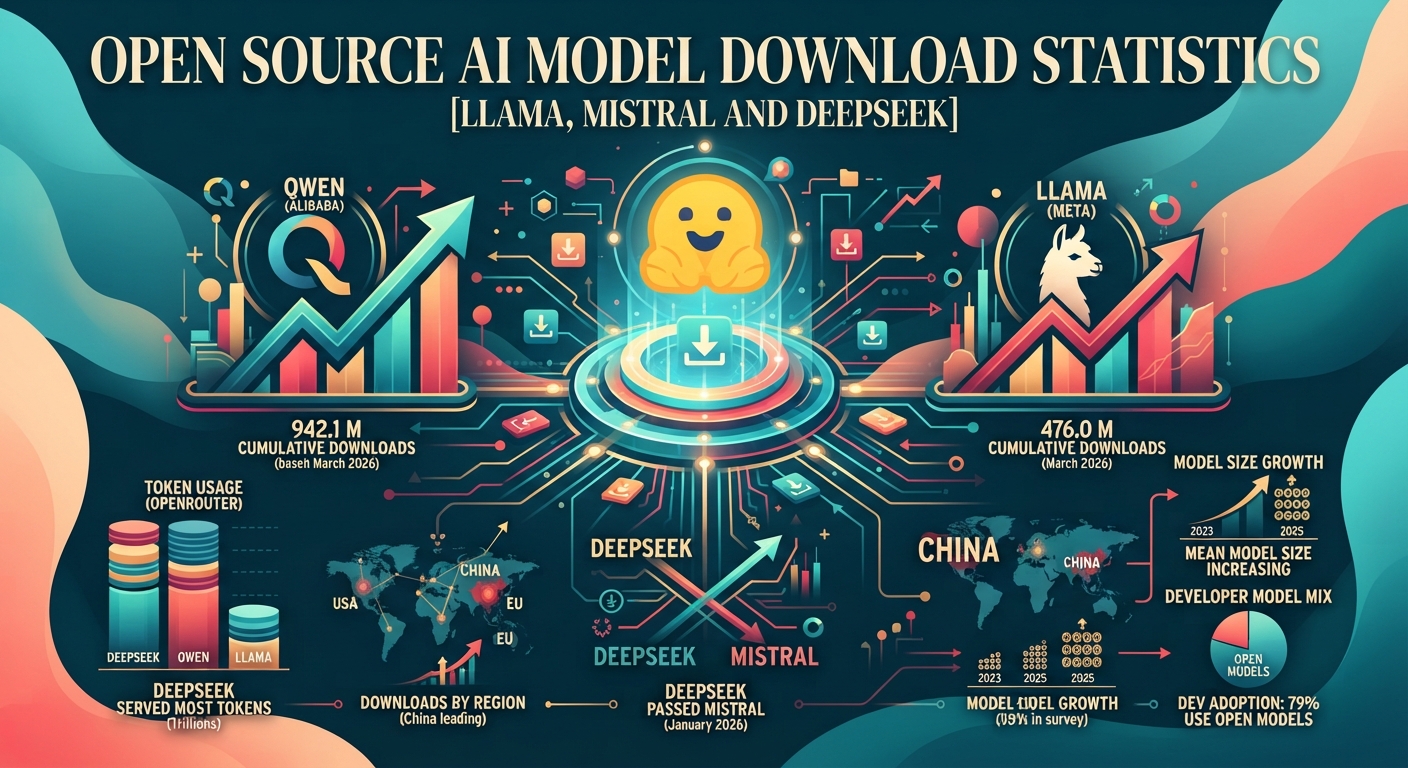
- Qwen reached 942.1 million cumulative downloads by March 2026. Llama reached 476.0 million.
- DeepSeek passed Mistral in January 2026, at 128.2 million against 124.3 million.
- DeepSeek served 14.37 trillion tokens on OpenRouter between November 2024 and November 2025, ahead of Qwen at 5.59 trillion and Meta Llama at 3.96 trillion.
- Meta announced 1 billion Llama downloads in March 2025. Google announced 1 billion Gemma downloads in August 2026.
- 79% of developers adding AI functionality use open models, against 71% for closed models.
How Many Times Have Llama, Mistral And DeepSeek Been Downloaded?
The ATOM Report tracks roughly 1,500 open language models and counts a download as any HTTP request to a model file hosting endpoint. Automated pulls from transformers or curl are included, so these are request counts rather than people.
Qwen passed Llama in September 2025, at 325.4 million against 323.7 million. Six months later the gap was 466.1 million.
| Model family | Cumulative downloads | Date |
|---|---|---|
| Qwen (Alibaba) | 942.1 M | March 2026 |
| Llama (Meta) | 476.0 M | March 2026 |
| Qwen (Alibaba) | 325.4 M | September 2025 |
| Llama (Meta) | 323.7 M | September 2025 |
Source: The ATOM Report, Interconnects AI, cumulative Hugging Face downloads, September 2025 and March 2026
DeepSeek and Mistral sit far below both, and close to each other. ATOM records the crossover between them at a single point.
| Model family | Cumulative downloads | Date |
|---|---|---|
| DeepSeek | 128.2 M | January 2026 |
| Mistral | 124.3 M | January 2026 |
Source: The ATOM Report, Interconnects AI, cumulative Hugging Face downloads, January 2026
Mistral led the ecosystem first. Its share of new derivative models peaked at 57% in December 2023 on the strength of Mistral 7B and Mixtral. Meta’s derivative share peaked at 44% in August 2024 and stood at 11% by February 2026.
Open Source AI Model Download Statistics By Region
ATOM assigns each model to the United States, China, or Europe by the headquarters of the releasing organization. Total tracked downloads reached 2.04 billion by March 2026, up from 339 million a year earlier.
| Region | March 2025 | March 2026 | Growth multiple |
|---|---|---|---|
| China | 97 M | 1.15 B | 11.9x |
| USA | 177 M | 723 M | 4.1x |
| EU | 65 M | 163 M | 2.5x |
Source: The ATOM Report, Interconnects AI, cumulative Hugging Face downloads, March 2025 and March 2026
None of the three regions shrank. The United States led China 177 million to 97 million in March 2025; by March 2026 the gap ran the other way, at 428 million. ATOM puts the crossover in late July 2025. Where those weights end up running is covered in these cloud provider Linux usage figures.
Which Open Models Serve The Most Tokens?
Downloads count how often weights are copied. Tokens count how much work a model does. OpenRouter and a16z published a study of more than 100 trillion tokens of real platform traffic, and the ranking inverts.
| Model author | Total tokens (trillions) |
|---|---|
| DeepSeek | 14.37 |
| Qwen | 5.59 |
| Meta LLaMA | 3.96 |
| Mistral AI | 2.92 |
| OpenAI | 1.65 |
| Minimax | 1.26 |
| Z-AI | 1.18 |
| TNGTech | 1.13 |
| MoonshotAI | 0.92 |
| 0.82 |
Source: OpenRouter and a16z, State of AI, tokens routed on OpenRouter, November 2024 to November 2025
Open-weight models reached roughly one third of all OpenRouter usage by late 2025. Across the one-year window, Chinese open models averaged 13.0% of weekly token volume, rest-of-world open models 13.7%, and proprietary rest-of-world models 70%.
ATOM’s own OpenRouter series shows the same reversal at model level. DeepSeek V3 and R1 together accounted for up to 75.6% of open model inference tokens in June 2025 and 31.1% by January 2026. Meta fell from a 37.4% peak in January 2025 to zero by August 2025.
Hugging Face Platform Statistics For Open Models
Hugging Face published its own audit in March 2026. The platform grew to 13 million users, more than 2 million public models and over 500,000 public datasets in 2025.
Attention is concentrated. About half of all models on Hugging Face have fewer than 200 total downloads, while the top 200 models, 0.01% of the total, account for 49.6% of all downloads.
On derivatives, Alibaba has more than Google and Meta combined. The Qwen family carries more than 113,000 derivative models, rising above 200,000 when every model tagging Qwen is counted.
| Metric | 2023 | 2025 |
|---|---|---|
| Mean size of downloaded open models | 827 M parameters | 20.8 B parameters |
| Median size of downloaded open models | 326 M parameters | 406 M parameters |
Source: Hugging Face, State of Open Source on Hugging Face: Spring 2026, published 17 March 2026
Hugging Face attributes the diverging mean to quantization and mixture-of-experts architectures pulling the top end upward while small-model usage stays flat. Mean engagement with a released model lasts about six weeks. Quantized local runners depend on toolchains described in these Go language usage statistics, and server-side pulls land in the stacks tracked by container and Kubernetes adoption data.
Who publishes the models people download?
Industry’s share of overall development fell from around 70% before 2022 to roughly 37% in 2025. Independent and unaffiliated developers rose from 17% to 39% of all downloads over the same period, at times passing half of total usage.
Source: Hugging Face and Longpre et al., Economies of Open Intelligence, share of Hugging Face downloads, 2022 to 2025
Do Developers Put Open Models Into Production?
Mozilla published its first State of Open Source AI report in July 2026, built on a developer survey fielded by SlashData in May 2026. Respondents were developers adding AI functionality to applications.
| Model type used | Share of developers |
|---|---|
| Open models | 79% |
| Closed models | 71% |
| Both | 50% |
| Open only | 29% |
| Closed only | 21% |
Source: Mozilla and SlashData 2026 developer survey, fielded May 2026. The first two rows overlap and are not exclusive shares.
Production is where the two diverge. Mozilla’s report page puts open-model teams reaching production at 53% against 63% for closed; Mozilla’s own blog post gives 51% against the same 63%. SlashData’s Álvaro Ruiz Cubero attributes the gap to missing infrastructure rather than model quality.
Greater China and East Asia lead open-model adoption at 89%, the highest of any region in the survey.
Vendor Download Statistics Versus Tracker Counts
Meta said Llama passed 1 billion downloads on 18 March 2025. Google said Gemma passed 1 billion on 20 August 2026, alongside more than 100,000 community variants published over two years. A Google engineer noted the Gemma tally excludes Android and Chrome integrations.
Neither figure is independently audited, and neither is broken out by platform. ATOM’s 476.0 million for Llama covers tracked text-generation models on Hugging Face only, which is why the two counts are not comparable.
Newer American labs are building from a much smaller base.
| Organization | Cumulative downloads since August 2025 |
|---|---|
| NVIDIA (Nemotron) | 30.7 M |
| Allen Institute for AI (OLMo) | 14.8 M |
| IBM (Granite) | 8.6 M |
Source: The ATOM Report, Interconnects AI, cumulative Hugging Face downloads to 27 March 2026
Mistral’s commercial position does not track its download position. The company announced a €1.7 billion Series C at a €11.7 billion post-money valuation on 9 September 2025, led by ASML. Repository activity across the wider ecosystem appears in these GitHub repository growth numbers.
Which model sizes get downloaded most?
The 7B to 9B parameter range captures 33.8% of all tracked downloads, the single largest bucket. Models under 10 billion parameters account for roughly 75%. DeepSeek is the exception at the top end, taking 47% of tracked downloads above 250 billion parameters, while Qwen leads sub-10B at 44%.
Source: The ATOM Report, Interconnects AI, share of tracked downloads, November 2023 to March 2026
Qwen’s monthly volume drives the totals. In February 2026 Qwen alone generated 153.6 million downloads, against 71.2 million combined from the eight next-largest open model organizations. Runtime choices underneath those pulls are covered in this container runtime market share breakdown and in these Linux ML infrastructure statistics.
FAQs
How many times has Llama been downloaded?
Meta announced 1 billion downloads in March 2025 across all channels. The ATOM Report, which tracks Hugging Face only, recorded 476.0 million cumulative Llama downloads by March 2026. The two counts use different scopes.
Has DeepSeek overtaken Mistral in downloads?
Yes. The ATOM Report recorded DeepSeek passing Mistral in cumulative Hugging Face downloads in January 2026, at 128.2 million against 124.3 million. Both trail Llama at 476.0 million as of March 2026.
Which open model handles the most usage?
DeepSeek. It served 14.37 trillion tokens on OpenRouter between November 2024 and November 2025, ahead of Qwen at 5.59 trillion and Meta Llama at 3.96 trillion. Tokens measure work done, not copies pulled.
Is r/LocalLLaMA a reliable measure of open model downloads?
No. Reddit activity measures forum discussion, not distribution. The ATOM Report counts a download as any HTTP request to a model file hosting endpoint, including automated pulls, which no forum metric captures.
Does a download equal a user?
No. ATOM defines a download as any HTTP request to a model file endpoint, so CI pipelines, bots and repeated pulls all count. One large deployment cached locally may register as a single download.
Sources
https://arxiv.org/html/2604.07190v1
https://openrouter.ai/state-of-ai
https://huggingface.co/blog/huggingface/state-of-os-hf-spring-2026
