


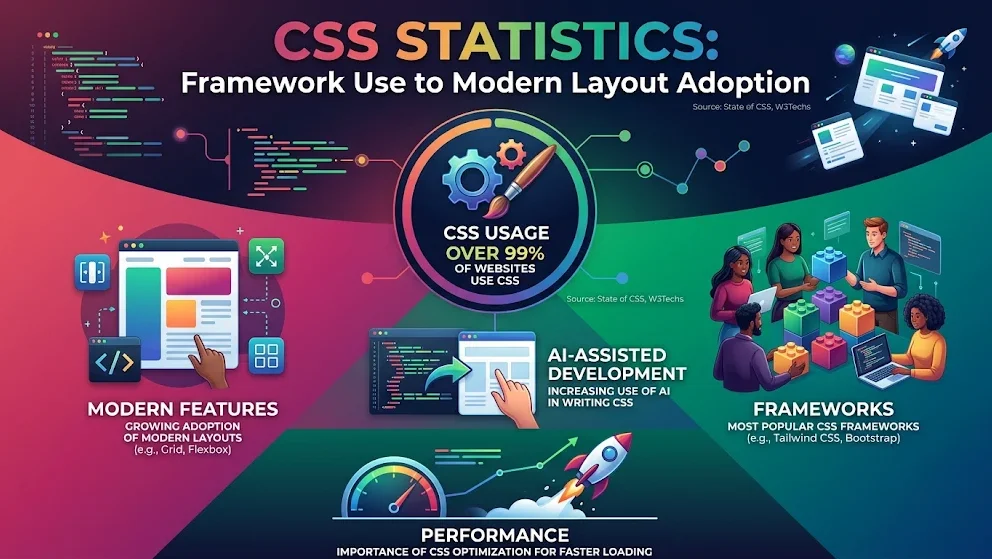
W3Techs detected CSS on 99.5% of websites as of 31 October 2026, so the open questions now sit one level down.
These CSS statistics cover feature adoption, frameworks, AI-written code, page weight and testing habits, drawn from W3Techs, State of CSS 2026, Project Wallace, the HTTP Archive Web Almanac 2025 and Stack Overflow’s 2026 survey.
CSS Statistics
How Many Websites Use CSS in 2026?
CSS appears on 99.5% of all websites W3Techs monitors. The share holds steady across traffic ranks, from 99.3% in the top 1 million to 99.7% in the top 1,000.
| Website group | Share using CSS |
|---|---|
| All websites | 99.5% |
| Top 1,000,000 | 99.3% |
| Top 100,000 | 99.4% |
| Top 10,000 | 99.5% |
| Top 1,000 | 99.7% |
Source: W3Techs, 31 October 2026
Inline styles are the most common delivery method, found on 93.9% of sites that use CSS. External stylesheets follow at 93.2%, and embedded <style> blocks at 83.8%.
W3Techs notes that one site can use several methods, so these shares overlap. Each method scores 1.0 on its top-site index, meaning it is as common among the top 1,000 sites as across all sites.
Source: W3Techs, subtechnology data 31 October 2026; top-site scores 5 November 2026
Modern CSS Feature Adoption on 100,000 Homepages
Project Wallace analyzed the homepage CSS of roughly 100,000 domains from the Majestic Million list for its first CSS Selection report. @media appears on 93.06% of those homepages, @container on 9.61% and @layer on 2.71%.
Tailwind CSS custom property names such as –tw-border-style top the @property list. Report author Bart Veneman ties most @property use to frameworks.
Source: Project Wallace, The CSS Selection, 2026 edition
Selectors, units and color formats
| Feature | Type | Share of analyzed homepages |
|---|---|---|
| :hover | Pseudo-class | 95.24% |
| :where() | Pseudo-class | 90.56% |
| :has() | Pseudo-class | 41.30% |
| :is() | Pseudo-class | 36.31% |
| px | Unit | 98.28% |
| rem | Unit | 80.15% |
| fr | Unit | 60.23% |
| dvh | Unit | 10.32% |
| oklch | Color format | 1.89% |
Source: Project Wallace, The CSS Selection, 2026 edition
:where() ranks second among pseudo-classes in that dataset, ahead of :focus at 88.57%. Old browser hacks persist, with the IE 6/7 *property hack on 18.75% of homepages.
Anchor Positioning Tops the State of CSS 2026 Wishlist and Blocklist
State of CSS 2026 ran from May 15 to June 29, 2026 and drew 4,902 opt-in responses. Anchor Positioning led the favorite new feature question with 168 mentions from 913 respondents, up four places on 2025.
The same feature tops the list of features developers avoid over browser support, with 121 mentions from 632 respondents. It also posted the survey’s largest year-over-year usage increase, at 15%.
| Feature avoided over browser support | Mentions (632 respondents) |
|---|---|
| Anchor Positioning | 121 |
| View Transition API | 58 |
| Scroll-driven animations | 45 |
| @function | 40 |
| if() | 34 |
| Customizable Select | 33 |
| @container size queries | 24 |
Source: State of CSS 2026, survey run May-June 2026
Which CSS features do developers use most?
:has() leads usage at 83.7% of respondents, followed by aspect-ratio at 81.3% and CSS Nesting at 70.6%. Gap decorations recorded the lowest usage, at 3.7%.
Respondents still saved gap decorations to their reading lists 1,823 times, more than any other item. Grid Lanes followed with 1,756 saves and calc-size() with 1,691.
Source: State of CSS 2026, survey run May-June 2026
Interop 2025 cross-browser results
97%of selected Interop 2025 tests passing in all browsers, end of 2025
Interop 2025 ended with 97% of selected tests passing in all browsers, up from 29% at the start of the year. Chrome Canary, Edge Dev, Firefox Nightly and Safari Technology Preview each scored 99%.
Safari Technology Preview climbed from 43 to 99, per WebKit, which states anchor positioning now works interoperably across browsers. Those 99% scores come from preview builds, while real visitor traffic splits across engines as our Blink, Gecko and WebKit share data shows.
Source: WebKit, Interop 2025 review, 6 February 2026
Which CSS Frameworks Lead in 2026?
Bootstrap runs on 13.0% of all websites W3Techs tracks, a 74.8% share among sites using a monitored framework. Tailwind sits at 0.3% of websites, a 1.8% framework share, while 82.6% of sites use none of the monitored frameworks.
Source: W3Techs, 4 November 2026
Developer surveys rank them differently. Tailwind CSS is the most selected framework among 3,697 State of CSS 2026 respondents, ahead of “None” and Bootstrap.
| Framework | Respondents (of 3,697) |
|---|---|
| Tailwind CSS | 1,854 |
| None | 1,042 |
| Bootstrap | 982 |
| shadcn/ui | 802 |
| Custom/in-house framework | 705 |
| Material UI | 692 |
Source: State of CSS 2026, survey run May-June 2026
Pre-processors and linting tools
Sass/SCSS leads pre- and post-processors with 2,032 of 3,656 answers, followed by PostCSS at 1,284. The survey authors describe pre-processor use as declining.
General formatters outrank CSS-specific tools: Prettier drew 2,589 of 3,695 answers and ESLint 2,418, against 1,147 for Stylelint. Editor choices sit in our VS Code, Vim and Emacs usage figures.
Source: State of CSS 2026, survey run May-June 2026
AI-Generated CSS Statistics
The median State of CSS 2026 respondent says 13% of their CSS is AI-generated, and 26% generate none at all. The question drew 3,732 answers.
Of those answers, 980 picked 0% and 64 picked the top bucket, 100% AI-written. Survey comments pointed to weak AI output for CSS.
Hand-learning is uneven as well: 290 of 3,701 respondents have learned about and tried most new features, while 1,144 tried some. CSS happiness averaged 4 out of 5, against 3.8 for web technologies in general.
Source: State of CSS 2026, survey run May-June 2026
What Does CSS Add to Page Weight?
The median mobile home page loaded 77 KB of CSS and 632 KB of JavaScript in the Web Almanac 2025 crawl, the same July 2025 dataset behind our WebAssembly adoption statistics. Desktop home pages loaded 82 KB of CSS.
Median CSS bytes grew 4 KB year over year, and the 90th percentile grew 8 KB. Pages make a median of 8 CSS requests on desktop and mobile, rising to 31 at the desktop 90th percentile.
Home and inner pages load the same median of 8 stylesheets. The chapter authors read this as sites shipping one CSS set across the whole site.
Every Minify CSS pass rate fell 1 point from 2024. Mobile home pages passed the Minify JavaScript audit at 63%.
| Page type (July 2025) | Passing Lighthouse Minify CSS audit |
|---|---|
| Desktop home pages | 61% |
| Mobile home pages | 62% |
| Desktop inner pages | 61% |
| Mobile inner pages | 61% |
Source: HTTP Archive Web Almanac 2025, Page Weight chapter, July 2025 crawl
Project Wallace measures uncompressed CSS rather than transferred bytes. Its median homepage ships 309 kB of CSS, and the 90th percentile 1.12 MB.
Source: Project Wallace, The CSS Selection, 2026 edition
Testing Environments and Browsers: CSS Statistics From 3,781 Developers
| Environment tested | Respondents (of 3,781) |
|---|---|
| Desktop | 3,774 |
| Smartphone | 2,510 |
| Tablet | 1,570 |
| Desktop with keyboard only | 1,300 |
| Testing tools (Axe, Lighthouse) | 1,054 |
| Screen reader | 799 |
| 477 |
Source: State of CSS 2026, survey run May-June 2026
Desktop testing is near universal at 3,774 respondents. Screen readers drew 799 answers and print 477.
Chrome is a primary development browser for 2,744 of 3,787 respondents, Firefox for 1,972 and desktop Safari for 953. Visitor-side page view shares appear in our Chrome vs Firefox vs Safari vs Edge comparison.
22% of respondents reported using a non-major browser, with Brave at 425 and Zen at 228.
Source: State of CSS 2026, survey run May-June 2026
How many developers use HTML/CSS?
HTML/CSS was used by 58.2% of 14,099 respondents in the Stack Overflow 2026 Developer Survey. SQL edged past it for second place at 58.4%, behind JavaScript at 62.0%.
Among respondents with 16+ years of work experience, HTML/CSS use stands at 56.4%. Rankings from other indices are compiled in our web development language statistics.
Source: Stack Overflow Developer Survey 2026, published October 2026
FAQs
What percentage of websites use CSS?
99.5% of all websites use CSS, according to W3Techs data from 31 October 2026. Usage reaches 99.7% among the top 1,000 sites and 99.3% among the top 1 million.
What is the most popular CSS framework?
Bootstrap leads on live websites at 13.0%, per W3Techs on 4 November 2026. Among State of CSS 2026 respondents, Tailwind CSS ranks first with 1,854 of 3,697 selections.
Which new CSS feature is used most?
:has() ranks first in State of CSS 2026 usage at 83.7% of respondents, ahead of aspect-ratio at 81.3%. Project Wallace’s 2026 crawl finds :has() on 41.30% of analyzed homepages.
Is CSS dying, as some Reddit threads claim?
No published dataset here shows a decline. W3Techs detects CSS on 99.5% of websites as of October 2026, and State of CSS 2026 respondents rated CSS happiness at 4 out of 5.
How much CSS is written by AI?
The median State of CSS 2026 respondent reports 13% of their CSS as AI-generated. 26% generate none, based on 3,732 answers collected May-June 2026.
Sources
https://w3techs.com/technologies/details/ce-css
https://2026.stateofcss.com/en-US/
