

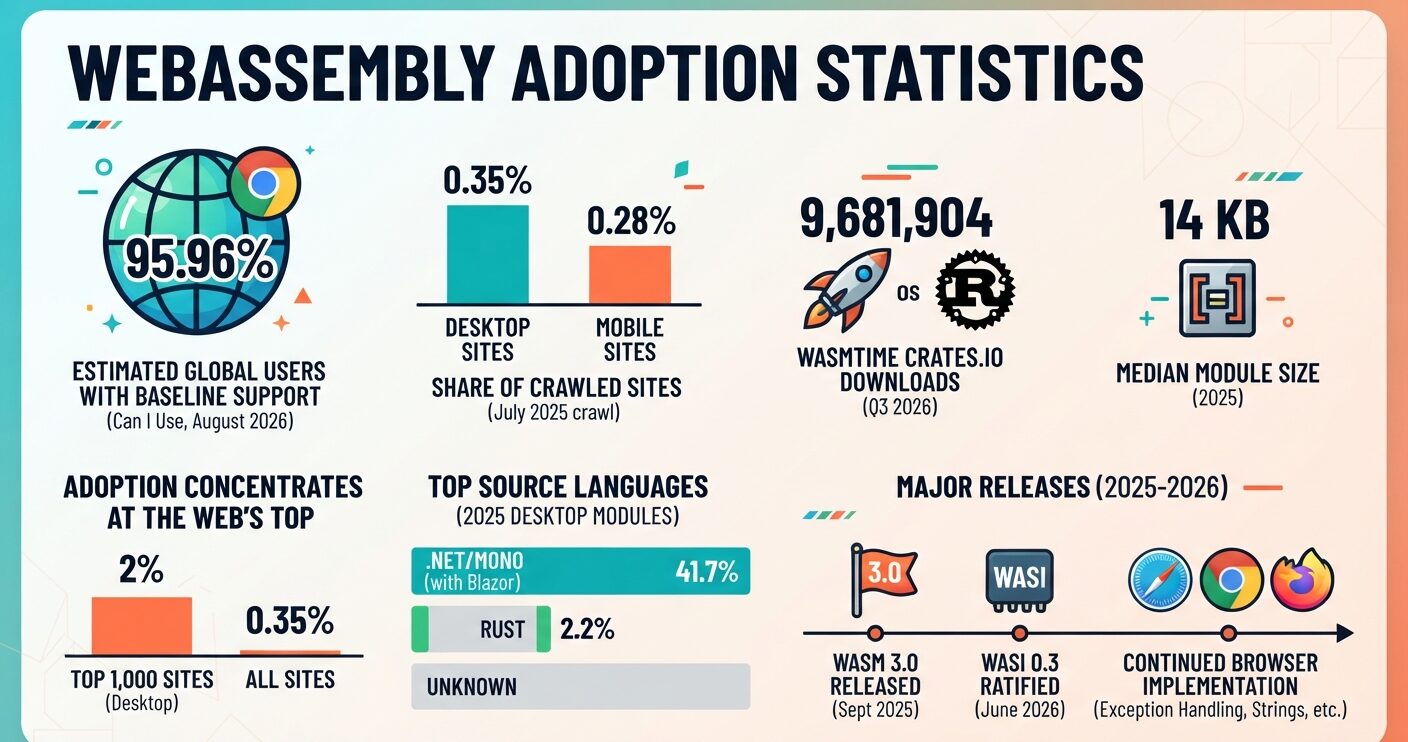
WebAssembly loaded on 0.35% of desktop sites and 0.28% of mobile sites in the July 2025 HTTP Archive crawl. Browser support is close to universal, yet deployment stayed flat year over year.
These WebAssembly adoption statistics cover site usage, source languages, feature use, module delivery, crates.io runtime downloads and the 2025 to 2026 standards releases.
WebAssembly Adoption Statistics
How Many Websites Use WebAssembly?
The HTTP Archive found WebAssembly on 0.35% of desktop sites and 0.28% of mobile sites in its July 2025 crawl, about 43,000 sites.
Desktop usage slipped from 0.36% in 2024. Mobile held at 0.28%.
The 2021 and 2022 editions each reported 0.06% of desktop domains and 0.04% of mobile domains. Each edition used its own crawl, so the jump between 2022 and 2024 reflects different samples as well as usage.
| Web Almanac edition | Desktop | Mobile |
|---|---|---|
| 2021 | 0.06% | 0.04% |
| 2022 | 0.06% | 0.04% |
| 2024 | 0.36% | 0.28% |
| 2025 | 0.35% | 0.28% |
Source: HTTP Archive Web Almanac, 2021, 2022 and 2025 WebAssembly chapters (2024 value as published in the 2025 chapter)
WebAssembly Adoption by Site Rank
Adoption concentrates at the top of the web. The top 1,000 sites reached 2% on desktop and 1.27% on mobile.
Outside the top 10 million, the rate falls to about 0.33% on desktop and 0.28% on mobile.
| Site rank group | Desktop sites with Wasm | Mobile sites with Wasm |
|---|---|---|
| Top 1,000 | 2% | 1.27% |
| All sites | 0.35% | 0.28% |
| Outside top 10 million | ~0.33% | ~0.28% |
Source: HTTP Archive Web Almanac 2025, July 2025 crawl
Why Do WebAssembly Usage Figures Disagree?
Two widely cited 2025 numbers measure different things. The Web Almanac counts sites in a crawl; its 2022 chapter noted that the crawl is primarily based on home pages.
Chrome Platform Status tracks WebAssembly use in Chrome browsing. Uno Platform reported in January 2026 that this metric rose almost one point during 2025 to 5.5%.
The Chrome figure covers Chrome traffic only. Engine shares for the same period appear in these global browser market share numbers.
Source: Uno Platform, The State of WebAssembly 2025 and 2026, January 2026, citing Chrome Platform Status
WebAssembly Adoption Statistics by Source Language
The Almanac’s language tool assigned 36.8% of desktop modules to .NET/Mono and 4.9% to Blazor. The chapter combines them into a 41.7% desktop share and 38.7% on mobile.
Rust accounted for 1.5% of desktop modules and 2.2% of mobile modules. Go and TinyGo each came in at about 0.1%; Go’s wider footprint shows up in Go developer usage data.
The figure labels 40.5% of desktop modules as unknown. The chapter text separately states that 35.7% of desktop modules could not be identified.
| Language label | Desktop modules | Mobile modules |
|---|---|---|
| Unknown | 40.5% | 45.5% |
| .Net Mono based language | 36.8% | 35.2% |
| LikelyEmscripten | 8.8% | 6.7% |
| Blazor | 4.9% | 3.5% |
| Scala | 3.6% | 3.4% |
| AssemblyScript | 2.4% | 2.3% |
| Rust | 1.5% | 2.2% |
| Emscripten | 1.3% | 1.1% |
| Go/TinyGo | ~0.1% | ~0.1% |
| TeaVM based language | ~0.1% | ~0.1% |
Source: HTTP Archive Web Almanac 2025, Figure 2.11, July 2025 crawl
Which WebAssembly Libraries Appear Most?
Import-name analysis ranks System at 43% of attributable Wasm requests, Microsoft at 23%, RXEngine at 6% and Dotnet at 6%.
Combined, Microsoft’s libraries and frameworks cover 78.8% on desktop and 79.3% on mobile, per the chapter.
Source: HTTP Archive Web Almanac 2025, July 2025 crawl
What Percentage of Browsers Support WebAssembly?
Can I Use estimates baseline WebAssembly support at 95.96% of global users. Every post-MVP feature it tracks sits between 94.92% and 95.53%.
SIMD has the lowest coverage in the set at 94.92%.
| Feature (Can I Use label) | Global users supported |
|---|---|
| WebAssembly | 95.96% |
| Import/Export of Mutable Globals | 95.53% |
| Multi-Value | 95.47% |
| Sign Extension Operators | 95.46% |
| Threads and Atomics | 95.45% |
| BigInt to i64 conversion in JS API | 95.44% |
| Non-trapping float-to-int Conversion | 95.43% |
| Bulk Memory Operations | 95.42% |
| Reference Types | 95.35% |
| SIMD | 94.92% |
Source: Can I Use dataset, updated 24 August 2026
Which WebAssembly Features Do Modules Actually Use?
Bulk memory appeared in 187,674 of 233,857 desktop modules and 204,103 of 255,060 mobile modules. Sign extension followed at 45,969 and 50,394.
Other post-MVP features tracked by the Almanac barely registered on its chart.
| Module count | Desktop | Mobile |
|---|---|---|
| All modules analysed | 233,857 | 255,060 |
| Bulk memory | 187,674 | 204,103 |
| Sign extension ops | 45,969 | 50,394 |
Source: HTTP Archive Web Almanac 2025, Figure 2.12, July 2025 crawl
WebAssembly Usage by Module Size and Delivery
The crawl logged 303,496 Wasm requests on desktop and 308,971 on mobile. Those resolved to 157,967 and 165,870 unique URLs.
Grouping by filename and size gave 87,596 unique desktop modules and 84,851 on mobile. The Almanac estimates about 72% of requests serve duplicate modules.
| Raw response size | Desktop | Mobile |
|---|---|---|
| 10th percentile | 2 KB | 2 KB |
| Median | 14 KB | 14 KB |
| 90th percentile | 381 KB | 316 KB |
| Largest module | 234 MB | 170 MB |
Source: HTTP Archive Web Almanac 2025, July 2025 crawl
How Are WebAssembly Modules Compressed?
Brotli carried 78.1% of desktop Wasm transfers, gzip 17.9% and Zstandard 3.9%. On mobile, Brotli reached 80.1%.
The application/wasm MIME type appeared on 293,470 desktop requests. Missing or incorrect types affected 3.2% of desktop and 2.4% of mobile requests.
Much of this encoding happens at the edge, where reverse proxy and CDN share is tracked separately.
Source: HTTP Archive Web Almanac 2025, Figure 2.6, July 2025 crawl (desktop)
Server-Side WebAssembly Adoption: crates.io Downloads
Wasmtime recorded 9,681,904 crates.io downloads in the 90 days to 21 September 2026, against 854,677 for Wasmer. Wasmtime’s latest stable release on crates.io is 48.0.2.
Download counts record Cargo fetches, including CI builds and indirect dependencies. They do not count users or production deployments.
| Crate | Downloads, last 90 days | All-time downloads |
|---|---|---|
| wasm-bindgen | 133,402,866 | 537,707,148 |
| wit-bindgen | 107,234,969 | 249,181,817 |
| wasmtime | 9,681,904 | 36,358,085 |
| wasmi | 4,155,483 | 23,224,333 |
| walrus | 2,642,597 | 14,227,190 |
| wasm-pack | 1,278,616 | 6,149,774 |
| wasmer | 854,677 | 8,511,917 |
Source: crates.io API, retrieved 21 September 2026
Function platforms remain the main alternative for this work; serverless adoption by cloud provider sets the baseline.
Wasm runtimes often ship alongside containers, and Kubernetes deployment figures show how large that host layer is.
WebAssembly Standards Timeline for 2025 and 2026
Wasm 3.0 became the live standard on 17 September 2025. It added a 64-bit address space, multiple memories, garbage collection, tail calls and exception handling, per WebAssembly.org.
WASI 0.3.0 was ratified on 11 June 2026, making async native to the Component Model’s canonical ABI, according to the Bytecode Alliance.
WASI 0.3 support first landed in Wasmtime 43. Wasmtime 46 and later enable it by default, per the WASI.dev roadmap.
WASI 0.3.1 followed as the first point release. The WASI project plans 0.3.x releases every two months.
The Rust compiler’s platform documentation lists wasm32-wasip3 at Tier 2 as of September 2026. It notes that cooperative multithreading was not yet supported on the target as of 3 September 2026.
Safari shipped exception handling with exnref in 18.4 and JavaScript string builtins in 26.2, as tracked by Uno Platform.
Linux hosts most of the cloud capacity these runtimes target; Linux share by cloud provider breaks that down.
Source: WebAssembly.org, September 2025; Bytecode Alliance, June 2026; WASI.dev roadmap and WASI GitHub releases, 2026; Rust compiler book, September 2026
FAQs
What percentage of websites use WebAssembly?
0.35% of desktop sites and 0.28% of mobile sites loaded a WebAssembly module in the July 2025 HTTP Archive crawl, about 43,000 sites. Chrome Platform Status puts its Chrome-only usage metric at 5.5%.
Which language is used most for WebAssembly?
.NET/Mono with Blazor. The 2025 Web Almanac gives it a combined 41.7% share of desktop modules and 38.7% on mobile. Rust sits at 1.5% on desktop and 2.2% on mobile.
Do all browsers support WebAssembly?
Can I Use estimates 95.96% of global users run a browser with baseline WebAssembly support, per its August 2026 dataset. SIMD support is slightly lower at 94.92%.
Is WebAssembly adoption growing?
Site share is flat. Desktop went from 0.36% in 2024 to 0.35% in 2025, and mobile stayed at 0.28%. Chrome’s usage metric rose almost one point during 2025 to 5.5%.
Is WebAssembly dead, as some Reddit threads ask?
No. The 2025 crawl found Wasm on about 43,000 sites, and Wasmtime logged 9,681,904 crates.io downloads in the 90 days to 21 September 2026. WASI 0.3 shipped in June 2026.
