


HTML runs on 97.8% of websites whose markup language W3Techs can identify, yet only 12.8% of 2,656 popular home pages passed ValidateHTML’s spec check in August 2026. These HTML statistics cover adoption, document size, tag and ARIA usage, validation errors, accessibility failures by framework and developer usage, drawn from five datasets released in 2025 and 2026.
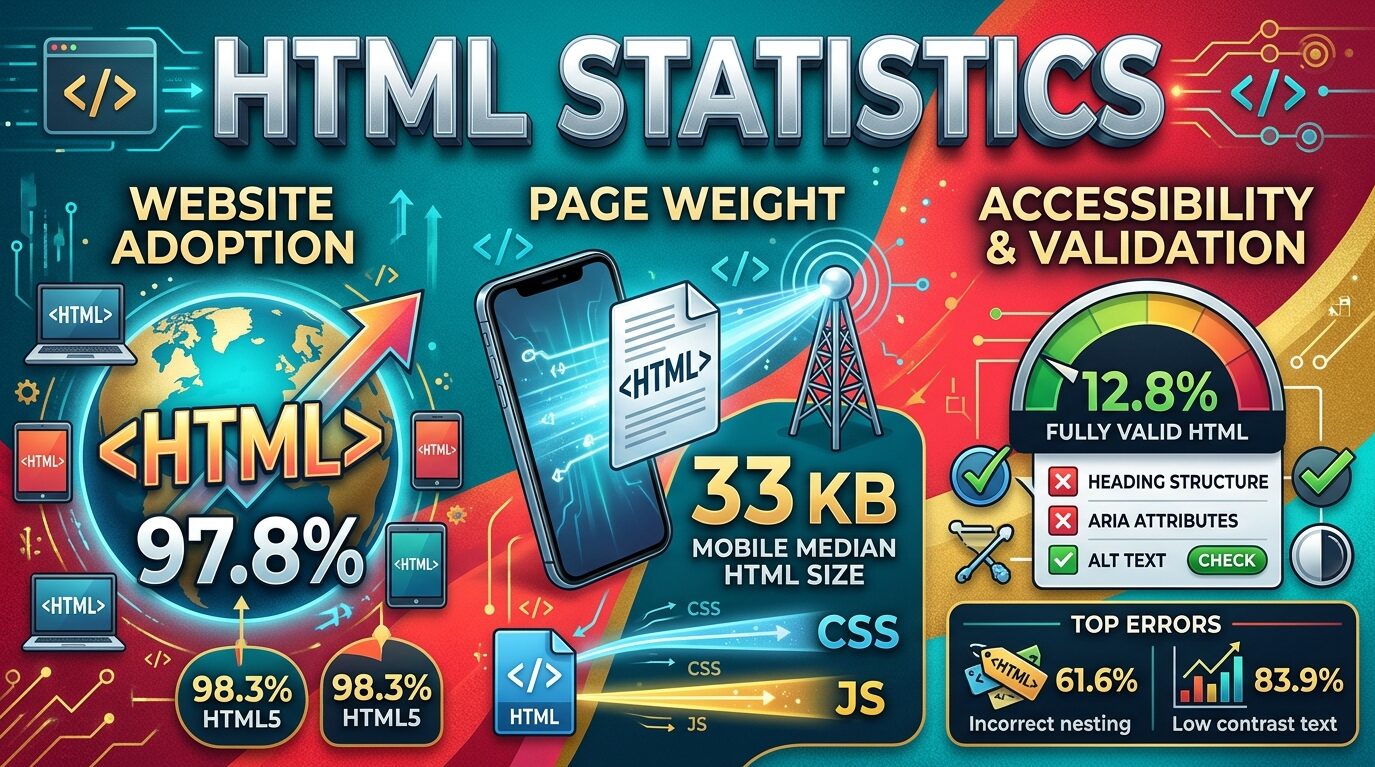
HTML Statistics
- 97.8%of websites with a known markup language use HTML (W3Techs, November 2026)
- 93.2%of the top one million home pages carry a valid HTML5 doctype (WebAIM, February 2026)
- 33 KBmedian HTML response size on mobile (HTTP Archive, July 2025 crawl)
- 12.8%of 2,656 top home pages have fully valid HTML (ValidateHTML, August 2026)
- 58.2%of Stack Overflow 2026 language respondents did extensive HTML/CSS work
How Many Websites Use HTML in 2026?
HTML appears on 97.8% of websites whose markup language W3Techs can detect. Within that group, 98.3% use HTML5, 2.6% HTML Transitional, 0.2% AMP and 0.1% HTML Strict, and a single site can use more than one.
Source: W3Techs, Usage statistics of HTML for websites, 5 November 2026
HTML5 share rose in every popularity tier between two W3Techs snapshots taken this year. The all-sites figure moved from 95.3% to 96.1%, and the top 1,000 from 97.0% to 97.6%.
| W3Techs popularity tier | HTML5, 15 Jan 2026 | HTML5, 31 Oct 2026 |
|---|---|---|
| Top 1,000 | 97.0% | 97.6% |
| Top 10,000 | 96.3% | 96.9% |
| Top 100,000 | 96.1% | 96.3% |
| Top 1,000,000 | 95.8% | 96.3% |
| All websites | 95.3% | 96.1% |
Source: W3Techs, HTML5 usage broken down by ranking, 15 January 2026 and 31 October 2026 (share of websites whose markup language is known)
W3Techs updates these reports daily and runs parallel surveys for categories such as web server software share.
HTML5 Doctype Adoption on the Top Million Home Pages
WebAIM found a valid HTML5 doctype on 93.2% of the top one million home pages in February 2026, up from 79.1% in 2021. The sample still contained 468 distinct doctypes.
Pages with the HTML5 doctype averaged 1,497 elements against 754 on other pages. They also averaged more detected errors, 56.4 versus 51.7.
Source: WebAIM Million, February 2026 (2021-2025 values as published in the same report)
Median Mobile HTML Document: 33 KB
HTML is the lightest of the three text resources in the HTTP Archive Web Almanac 2025. At the median, a mobile page shipped 33 KB of HTML, 79 KB of CSS and 646 KB of JavaScript.
Source: HTTP Archive Web Almanac 2025, Page Weight chapter, July 2025 crawl (home and inner pages combined)
| Percentile | Desktop HTML | Mobile HTML |
|---|---|---|
| 10th | 6 KB | 6 KB |
| 25th | 14 KB | 14 KB |
| 50th | 35 KB | 33 KB |
| 75th | 78 KB | 76 KB |
| 90th | 152 KB | 151 KB |
Source: HTTP Archive Web Almanac 2025, HTML response sizes by device, July 2025 crawl
Desktop and mobile HTML stay within 2 KB of each other through the 90th percentile. The Almanac authors read this as a sign that most sites serve one page to both device types, a split you can compare against browser share by device.
The extremes break the pattern. The largest HTML response hit 401.6 MB on desktop and 389.2 MB on mobile, while the median page now requests 3 HTML files, up from 2.
Binary payloads sit outside these figures, and the same Almanac edition reports WebAssembly module adoption in a separate chapter.
Do Popular Websites Have Valid HTML?
ValidateHTML requested the home pages of the Tranco top 5,000 in August 2026 and got a readable page from 2,656. Of those, 2,315 sites (87.2%) broke the written HTML standard at least once, and 341 (12.8%) had fully valid HTML.
Only 68 sites (2.6%) returned zero errors and zero best-practice warnings. The median site logged 11 errors, the mean 37.8 and the worst 1,392.
Source: ValidateHTML, HTML & CSS Error Statistics, crawl dated 14 August 2026
| HTML problem category | Share of 2,656 sites |
|---|---|
| Incorrect nesting | 61.6% |
| Invalid attribute value | 29.7% |
| Duplicate id | 23.2% |
| Deprecated attribute | 19.0% |
| Missing alt attribute | 19.0% |
| Unclosed tag | 16.1% |
| Deprecated element | 6.3% |
| Missing doctype | 2.3% |
Source: ValidateHTML, August 2026. One site can appear in several rows, so shares do not add up.
ValidateHTML ties the nesting errors to framework components dropped into parents that do not permit them, with <style> inside <div> as the most widespread wording. It places the cause at build time, the stage where CI/CD pipeline checks run.
CSS failed differently. 64.5% of 2,471 measured sites had a CSS error, but the median count was 1.
Why Some Reports Quote 90.5%
The first edition, published 11 August 2026, reported that 90.5% of sites broke the spec. ValidateHTML then moved three rules the HTML standard does not require, including title on <iframe> and lang on <html>, out of the error column.
The corrected crawl returned 87.4%, and the current figure stands at 87.2%. The 2.6% fully clean share did not change.
Source: ValidateHTML, corrections log, 13-14 August 2026
HTML Tag Usage Statistics From the WebAIM Million 2026
Top home pages averaged 1,437 elements in February 2026, up 14.3% in one year. WebAIM found a detected accessibility error on 3.9% of all elements, or 1 in every 26.
Heading Levels by Share
WebAIM counted nearly 30 million headings, or 29.9 per page, and the total grew 20.4% in a year. <h3> was the most common level at 37.5%, ahead of <h2> at 29%.
Structure problems grew too. Skipped heading levels appeared on 41.8% of pages, up from 39%, and 18.1% used more than one <h1>, up from 16.3%.
Source: WebAIM Million, February 2026 (share of all detected headings)
ARIA Attributes vs Native HTML Elements
| Home page metric (top 1M) | 2025 | 2026 |
|---|---|---|
| HTML elements per page | 1,257 | 1,437 |
| ARIA attributes per page | 106 | Over 133 |
| aria-hidden=”true” per page | 18 | 23.3 |
| role=”button” per page | 3.6 | 4.8 |
| Pages using ARIA (excl. landmark roles) | 79.4% | 82.7% |
| Pages with a <main> element or landmark | 42.6% | 46.1% |
| Pages with a skip link | 15.3% | 17.1% |
| Pages with no headings | 9.8% | 7.5% |
Source: WebAIM Million, February 2026 and February 2025 editions
ARIA attributes grew 27% in a year, while element counts grew 14.3%. Pages with ARIA averaged 59.1 detected errors against 42 on pages without it, and WebAIM notes those pages were also more complex.
ValidateHTML’s separate crawl flagged a “prefer the native <button> element” warning on 42.0% of its 2,656 sites. That finding is a best-practice warning, not a spec violation.
Data tables show a similar gap. Only 19% of the 948,225 tables WebAIM found had valid data table markup.
Which JavaScript Frameworks Ship the Most HTML Accessibility Errors?
95.9% of the top one million home pages had detected WCAG 2 failures in February 2026, up from 94.8%. That reversed six straight years of small improvements, and errors averaged 56.1 per page against 51 in 2025.
Low contrast text (83.9%), missing image alt text (53.1%) and missing form labels (51%) were the most common failures.
| Framework detected | Home pages | Avg. detected errors | vs. 56.1 average |
|---|---|---|---|
| Astro | 5,472 | 9.0 | -84.0% |
| Next.js | 23,863 | 40.9 | -27.1% |
| React | 45,673 | 43.5 | -22.5% |
| Nuxt.js | 14,232 | 54.7 | -2.6% |
| Vue.js | 55,049 | 64.6 | +15.1% |
| AMP | 23,261 | 65.0 | +15.9% |
| AngularJS | 6,054 | 76.6 | +36.4% |
| Firebase | 8,426 | 82.9 | +47.7% |
Source: WebAIM Million, February 2026
WordPress showed up on 252,302 home pages and averaged 52.8 errors. jQuery, present on 560,294 pages, averaged 64.9.
WebAIM cautions that extra errors cannot always be attributed to a technology. It says the overall rise likely reflects heavier use of third-party frameworks and AI-assisted coding, which it calls “vibe coding”.
Developer Usage of HTML/CSS, 2018-2026
Stack Overflow’s opt-in 2026 survey counted 8,212 of 14,099 language respondents doing extensive HTML/CSS work, or 58.2%. The survey treats HTML and CSS as one answer option.
The highest reading in the 2018-2026 series was 68.5% in 2018. The share fell to 52.9% by 2024, then rose to 61.9% in 2025, and each year draws a different respondent pool.
Source: Stack Overflow Developer Survey 2026, languages time series, all respondents
HTML/CSS ranked third in 2026, behind JavaScript (62.0%) and SQL (58.4%) and ahead of Python (58.0%). TIOBE and GitHub order these languages differently, as this web development language comparison shows.
| Language | Desired (want to use next year) | Admired (users who want to keep it) |
|---|---|---|
| Python | 33.4% | 50.6% |
| SQL | 32.0% | 51.4% |
| HTML/CSS | 29.0% | 47.8% |
| JavaScript | 27.8% | 42.0% |
| TypeScript | 27.5% | 53.0% |
Source: Stack Overflow Developer Survey 2026, n = 14,099
More respondents want HTML/CSS next year than JavaScript or TypeScript. Its admired score trails TypeScript, SQL and Python.
htmx, a library that extends HTML attributes, was used by 5.4% of 10,281 web framework respondents. It earned a 55.9% admired score in the same 2026 survey.
FAQs
How many websites use HTML in 2026?
97.8% of websites with a known markup language use HTML, per W3Techs in November 2026. HTML5 alone reached 96.1% of those websites on 31 October 2026.
What percentage of websites have valid HTML?
Just 12.8% of 2,656 popular home pages had fully valid HTML in ValidateHTML’s August 2026 crawl. Adding best-practice warnings to the test leaves 2.6% completely clean.
How large is a typical HTML file?
Median HTML responses measured 33 KB on mobile and 35 KB on desktop in HTTP Archive’s July 2025 crawl. At the 90th percentile, sizes reached 151 KB and 152 KB.
Is HTML still worth learning, as Reddit threads keep asking?
Survey data points to steady use. In Stack Overflow’s opt-in 2026 survey, 58.2% of 14,099 language respondents did extensive HTML/CSS work, and 29.0% want to use it next year.
What is the most common accessibility error on home pages?
Low contrast text, found on 83.9% of the top one million home pages in WebAIM’s February 2026 analysis. Missing image alt text (53.1%) and missing form labels (51%) ranked next.
Sources
https://w3techs.com/technologies/details/ml-html_any
https://webaim.org/projects/million/
