

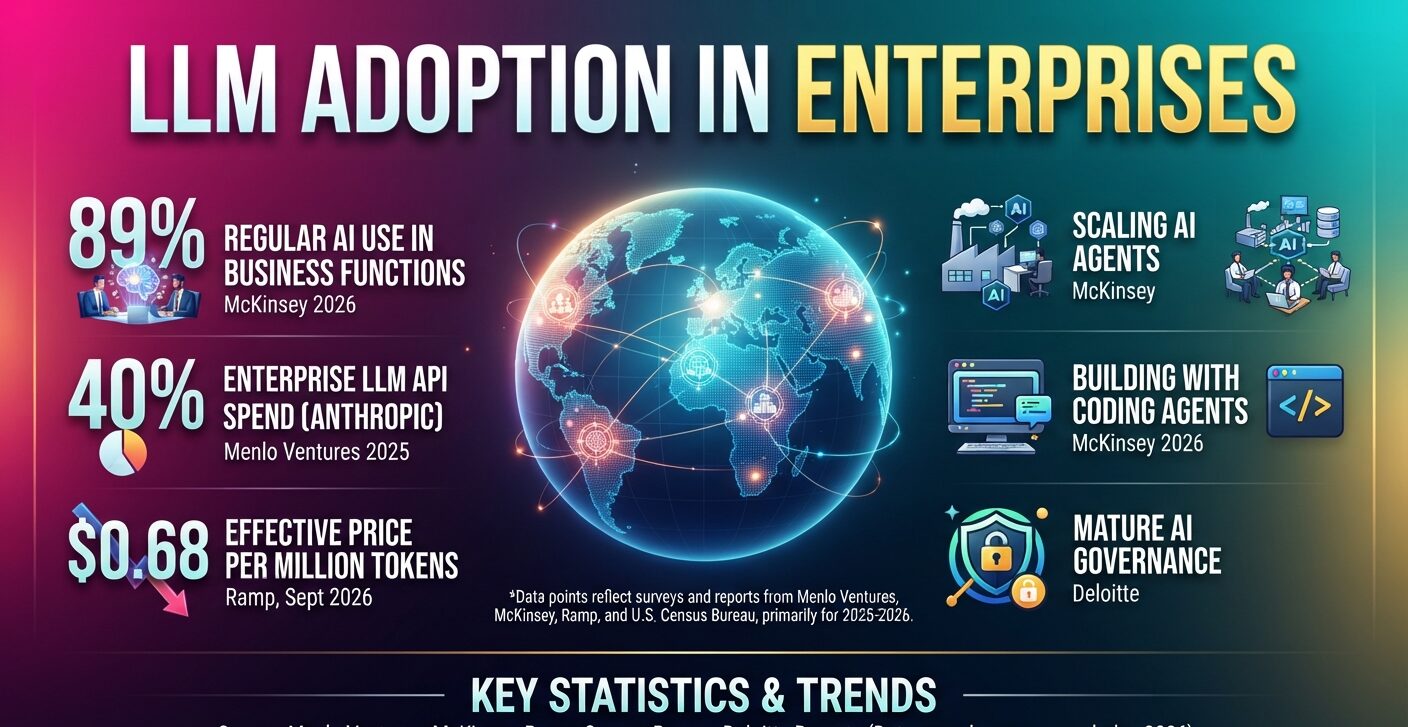
Anthropic took 40% of enterprise LLM API spend in 2025, OpenAI 27% and Google 21%, according to Menlo Ventures. Vendor share is one lens on LLM adoption in enterprises.
This brief adds McKinsey’s August 2026 survey, Census Bureau data through May 2026, Ramp’s September 2026 spend index and Deloitte’s 2026 report, covering vendors, spend, firm size, agents, coding, ROI and headcount.
LLM Adoption in Enterprises Statistics
Anthropic’s share of enterprise LLM API spend in 2025 (Menlo Ventures)
McKinsey 2026 respondents reporting regular AI use in at least one business function
Organizations with $1B+ revenue scaling AI agents in 2026, up from 27% (McKinsey)
Effective price per million tokens in early September 2026, down 41% from March (Ramp)
U.S. businesses using AI in a business function, period ending May 3, 2026 (Census Bureau)
Enterprise LLM Adoption by Vendor: Anthropic 40%, OpenAI 27%
Anthropic held 40% of enterprise LLM API spend in 2025, up from 24% in 2024 and 12% in 2023. OpenAI fell to 27% from 50% in 2023.
Google rose to 21% from 7% in 2023. Meta’s Llama, Cohere, Mistral and smaller providers split the remaining 12%.
| Provider | 2023 | 2024 | 2025 |
|---|---|---|---|
| Anthropic | 12% | 24% | 40% |
| OpenAI | 50% | Not published | 27% |
| 7% | Not published | 21% | |
| Others | Not published | Not published | 12% |
Source: Menlo Ventures, 2025: The State of Generative AI in the Enterprise, December 2025 (shares estimate dollars spent from production API usage; survey of 495 U.S. enterprise AI decision-makers, November 7–25, 2025)
Coding is more concentrated. Anthropic held an estimated 54% of the enterprise coding market in the same report, against 21% for OpenAI.
What Share of Businesses Pay Each LLM Vendor?
Ramp’s card and bill-pay data measures a different thing: the share of U.S. businesses on its platform paying a model vendor in a given month.
In August 2026, 43.8% paid Anthropic, up 0.34 points month over month. OpenAI reached 39.8%, up 0.09 points.
Source: Ramp AI Index, September 2026 update (August 2026 transaction data)
Open-Weight Models in the Enterprise
Open-source models held 11% of enterprise LLM usage in Menlo’s 2025 data, down from 19% a year earlier. Chinese open models made up about 1% of total LLM API usage.
Source: Menlo Ventures, 2025: The State of Generative AI in the Enterprise, December 2025
Ramp counts 6.4% of AI-spending businesses and 3.6% of all businesses using routing platforms that serve open models. Ramp notes this proxy likely overstates open-source use.
Source: Ramp AI Index, September 2026 update (August 2026 data)
For a non-spend view of the same models, see our open-weight model download counts.
How Much Are Enterprises Spending on LLMs?
Enterprise generative AI spend reached $37 billion in 2025, up from $11.5 billion in 2024 and $1.7 billion in 2023, per Menlo Ventures. The estimate excludes chips, inference and model serving, and AI features built into existing software.
Applications took $19 billion and infrastructure $18 billion. Infrastructure spend doubled from $9.2 billion in 2024.
| 2025 spend category | Layer | Spend |
|---|---|---|
| Foundation model APIs | Infrastructure | $12.5B |
| Horizontal AI (copilots, agent platforms) | Application | $8.4B |
| Departmental AI (coding, IT, marketing) | Application | $7.3B |
| Model training infrastructure | Infrastructure | $4.0B |
| Vertical AI (healthcare, legal, government) | Application | $3.5B |
| AI infrastructure (data, retrieval, orchestration) | Infrastructure | $1.5B |
Source: Menlo Ventures, 2025: The State of Generative AI in the Enterprise, December 2025 (calendar-year 2025 estimates)
Coding was the largest departmental category at $4.0 billion, up from $550 million in 2024. Teams wiring model APIs into products can compare tooling in our API tools stack guide.
Enterprises bought 76% of AI use cases in 2025, against 53% in 2024. Hosting patterns for the build side appear in serverless adoption by cloud provider.
Token Prices and Per-Employee AI Spend in 2026
Ramp’s effective price per million tokens fell 41% to $0.68 in the week of September 9, 2026, from a 2026 peak of $1.15 in March.
Frontier models drove 45% of token share in early September, down from a 53% peak in August.
Monthly AI spend per employee at the top 1% of firms fell 9.7%, from $7,976 in July to $7,205 in August 2026. Ramp revised July upward and flags this series as volatile.
Source: Ramp AI Index, September 2026 update (July–September 2026 data)
Size Gap in Enterprise LLM Adoption: $1B+ Firms vs Smaller Ones
89% of McKinsey’s 2026 respondents report regular AI use in at least one function, against 88% in 2025. 44% report AI scaling across the enterprise, up from 38%.
| McKinsey 2026 measure | Revenue $1B or more | Revenue under $1B |
|---|---|---|
| Scaling AI across the enterprise | 54% | About one-third |
| Scaling AI agents in 1+ functions | 40% | 22% |
| Scaling AI chatbots | 64% | 39% |
Source: McKinsey, The State of AI in 2026: On the Road to ROI, August 2026 (survey of 1,719 participants in 97 nations, May 4–June 8, 2026; tool rows rebased to the full sample, n = 595 and 1,035)
Agent scaling at large organizations rose 13 points in a year. Smaller organizations stayed flat.
McKinsey weights results by each nation’s share of global GDP. 36% of respondents work at organizations above $1 billion in revenue.
How Many U.S. Businesses Use AI?
Census data covers U.S. businesses of every size, so its rate runs far below enterprise-panel surveys. It also measures AI broadly, not LLMs alone.
| Segment | Current AI use |
|---|---|
| All U.S. businesses | 19.8% |
| Firms with 250+ employees | 37% |
| Firms with 100–249 employees | 32% |
| Information sector | 39.7% |
| Finance and Insurance | 33.9% |
| Retail Trade | Around 14% |
Source: U.S. Census Bureau, Business Trends and Outlook Survey, collection period ending May 3, 2026 (published May 26, 2026)
National use hovered between 17% and 20% from December 2025 to May 2026. Between 20% and 23% of businesses expected to use AI within six months.
AI use rose among firms with 20 or more employees but did not change significantly below that size. Firms with four or fewer employees stayed under 20%.
Where Do AI Agents Run, and Who Governs Them?
Chatbots are the most scaled AI tool in McKinsey’s 2026 survey, at 47% of respondents. About two in ten report AI agents at the scaling phase.
By function, agent scaling is highest in IT at 12% of respondents, knowledge management at 11% and software engineering at 10%. Infrastructure context for IT teams sits in our container runtime share data.
Source: McKinsey, The State of AI in 2026, August 2026 (survey May 4–June 8, 2026)
Menlo Ventures found 16% of enterprise deployments and 27% of startup deployments qualify as true agents. The rest run fixed-sequence or routing workflows around a model call.
Source: Menlo Ventures, 2025: The State of Generative AI in the Enterprise, December 2025
Deloitte puts mature agent governance at 21% of companies. Close to three-quarters plan to deploy agentic AI within two years, and 85% expect to customize agents.
Vendor origin shapes procurement: 77% factor a supplier’s country of origin into selection, and 83% call sovereign AI important to strategic planning. Almost 3 in 5 build AI stacks mainly with local vendors.
Source: Deloitte AI Institute, State of AI in the Enterprise 2026 (survey of 3,235 business and IT leaders in 24 countries, August–September 2025)
McKinsey’s high performers are much more likely than others to mitigate AI-driven exploitation of technical vulnerabilities and unauthorized or unintended AI actions. Vulnerability reward data appears in bug bounty payouts by platform.
Source: McKinsey, The State of AI in 2026, August 2026
32% Skipped a Software Purchase to Build With Coding Agents
32% of McKinsey’s 2026 respondents say their organization decided against buying at least one software product or feature because it could be built in-house with agentic coding tools.
Technology respondents report it most at 41%, followed by healthcare payers and providers at 39%. Public and social sector respondents report it least at 17%.
About two in ten organizations scale software coding agents, rising to 31% at larger enterprises. Almost half of high performers have forgone a purchase this way, against 31% of other respondents.
Source: McKinsey, The State of AI in 2026, August 2026 (asked of respondents at organizations using AI; survey May 4–June 8, 2026)
Does LLM Adoption in Enterprises Pay Off?
37% of McKinsey’s 2026 respondents attribute some EBIT impact to AI, about the same as in 2025. 6% qualify as high performers, attributing 5% or more of EBIT to AI and calling the value significant.
Individual gains run higher. 80% say AI improved their own productivity, and 50% say it helps them make better decisions.
Almost three-quarters of high performers have redesigned workflows because of AI, up from 55% a year earlier. One-quarter of other respondents report the same.
Costs constrain a minority. 20% say AI operating costs, including tokens, limited their AI use, with technology respondents highest at 25%.
Budgets keep rising. 60% expect AI investment to increase next year, and 28% already spend more than 10% of their ICT budget on AI.
Source: McKinsey, The State of AI in 2026: On the Road to ROI, August 2026 (survey May 4–June 8, 2026)
Deloitte found 25% of respondents have moved 40% or more of AI pilots into production, and 54% expect to within three to six months. 30% are redesigning key processes around AI.
Source: Deloitte AI Institute, State of AI in the Enterprise 2026 (survey August–September 2025)
Once a buyer commits to exploring an AI product, 47% of deals reach production, against 25% for traditional SaaS.
Source: Menlo Ventures, 2025: The State of Generative AI in the Enterprise, December 2025
Three in four enterprise leaders in the Wharton and GBK Collective study report positive returns on generative AI. 72% track ROI metrics such as productivity, profitability and throughput.
Source: Wharton Human-AI Research and GBK Collective, Accountable Acceleration: Gen AI Fast-Tracks Into the Enterprise, October 2025
LLM Adoption and Headcount: 14% Reported Cuts, 39% Expect Them
14% of McKinsey respondents at AI-using organizations report an AI-related workforce decline over the past year. In 2025, 32% had expected declines over that period.
For the year ahead, 39% expect declines and 43% expect little or no change. Two-thirds report little or no AI-related change over the past year.
Source: McKinsey, The State of AI in 2026, August 2026 (2025 survey June 25–July 29, 2025, n = 1,753; 2026 survey May 4–June 8, 2026, n = 1,521; figures may not sum to 100% because of rounding)
FAQs
What percentage of enterprises use LLMs?
Regular AI use reached 89% of respondents’ organizations in McKinsey’s May–June 2026 survey, with 44% scaling it enterprise-wide. Census data puts U.S. business AI use at 19.8% for the period ending May 3, 2026.
Which LLM do enterprises use most?
Anthropic led enterprise LLM API spend in 2025 at 40%, ahead of OpenAI at 27% and Google at 21%, per Menlo Ventures. Ramp’s August 2026 data shows 43.8% of its businesses paying Anthropic.
How much do enterprises spend on generative AI?
$37 billion in 2025, up from $11.5 billion in 2024, by Menlo Ventures’ estimate. Foundation model APIs took $12.5 billion of that total.
How many enterprises run AI agents at scale?
Forty percent of organizations with $1 billion or more in revenue were scaling AI agents in 2026, versus 22% of smaller ones, per McKinsey. Menlo found 16% of enterprise deployments qualify as true agents.
Do Reddit discussions about enterprise LLM pilots stalling match the data?
Reddit threads are self-selected anecdotes, not measured data. Deloitte’s survey found 25% of organizations had moved 40% or more of AI pilots into production, with 54% expecting to within three to six months.
Citations
https://menlovc.com/perspective/2025-the-state-of-generative-ai-in-the-enterprise/
https://ramp.com/data/ai-index-sept-2026
https://www.census.gov/library/stories/2026/05/ai-use-businesses.html
