

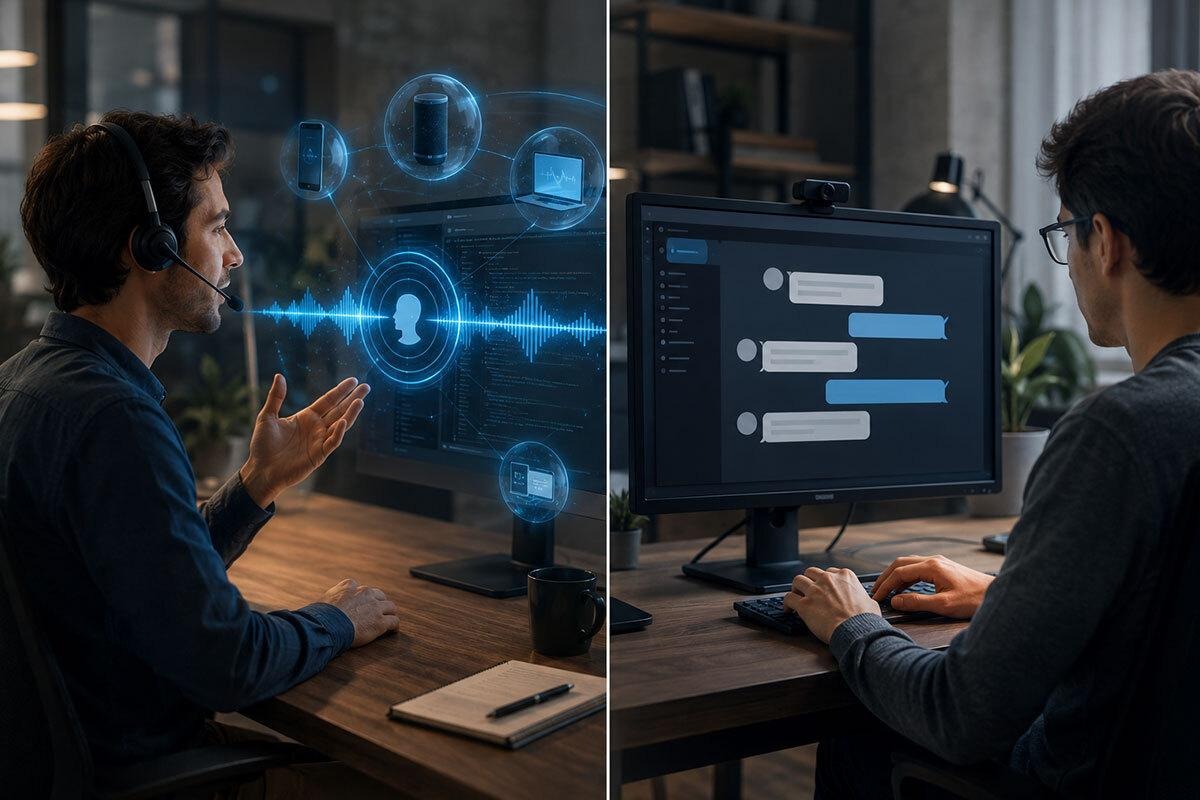
The creation of applications capable of interacting with users has become one of the main goals in recent years.
For many years, it has been the norm to implement traditional chatbots based on text communication to automate conversations between representatives and customers.
These chatbots cope fairly well with dealing with basic queries, navigation within simple menus, and text input.
Nowadays, people have come up with different demands towards the user experience provided by applications.
The development of this direction has led to the creation of voice artificial intelligence as an alternative approach.
For engineering teams tasked with building next-generation applications, it is necessary to understand the distinction between the two approaches mentioned above.
Technical Architecture: Rules vs. Real-Time Pipelines
The core distinction that separates a typical chatbot from a more contemporary voice agent is the manner in which they analyze the data and process information.
Traditional Chatbots
Typical traditional chatbots depend on hard-coded rule-based trees or conventional NLP processes for matching text-based inputs to defined intents. The process itself tends to be quite straightforward:
- Input: The user types a text string.
- Parsing: The system applies string matching or regex to identify keywords.
- Intent Mapping: The text is categorized into a static intent bucket.
- Output: The system fetches a pre-written text response from a database.
Because the data format remains text-to-text, computational overhead is low, and architectural complexity is minimal.
AI Voice Agents
An AI voice agent runs using a continuous multimodal pipeline that is required to perform real-time processing of audio streams. There are three different systems that should work harmoniously within the technology stack:
- Automatic Speech Recognition (ASR): Converts live audio streams into text while filtering background noise.
- Large Language Models (LLMs) & Reasoning: Processes the text, analyzes sentiment, applies context, and determines the appropriate response or function call.
- Text-to-Speech (TTS): Converts the generated text back into high-fidelity, natural human speech.
For engineering teams, moving from text to speech means managing substantial data infrastructure upgrades. Instead of processing simple HTTP POST requests containing text strings, you must manage continuous WebSockets or WebRTC audio streams, handle packet loss, and ensure low execution latency.
The Latency Challenge
For text-based communication, a lag of one or two seconds is completely fine. People are used to seeing a “typing…” notification when a server handles an API request or searches a database.
Voice interaction, however, cannot continue to be a conversation for even two seconds of latency since, due to its nature, it requires great time coordination between the parties involved.
When the response is delayed for more than one second, users consider the problem to be in the system, which creates additional friction.
In order to implement a functional voice-based application, engineers need to fine-tune all milliseconds of its work. This can be done only by employing extremely efficient models optimized specifically for real-time systems.
Leveraging a dedicated voice agent for developer architecture lets teams set up systems with latencies below 800 milliseconds.
Such a task can be accomplished by optimizing text output from the language model and processing it instantly through the TTS engine without the delay inherent in traditional paragraph-by-paragraph generation.
Contextual Awareness and State Management
Conversational state management is yet another place where these two technologies differ greatly.
Standard chatbots traditionally function using either a stateless approach or a very restricted state management technique.
They follow strict decision trees that ask the user to do specific actions (e.g., “Press 1 for Billing, Press 2 for Support”).
In case the user does not follow the decision tree and makes any other statement not mapped by the bot, it will likely fail, returning “I couldn’t understand your query. Please try again.”
Voice assistants leverage Retrieval-Augmented Generation and dynamic context mapping techniques, making it easy for them to manage open-ended, multi-turn conversations.
In case a user interrupts a conversation mid-way, switches topics, or refers to something discussed some time ago, the assistant will keep track of the conversational state and adapt its responses accordingly.
APIs and Actionable Integrations
A great conversational interface needs to do more than just talk; it must execute tasks. Both traditional chatbots and voice agents achieve this via API integrations, but the execution method is quite different.
Generally speaking, chatbots fire webhooks at predetermined nodes within the conversation tree. For example, once a customer enters four text boxes in order to book an appointment, a JSON webhook is sent to a calendar integration.
On the other hand, voice agents make use of real-time function calls using the natural language model layer.
In the process of receiving an unstructured audio feed, the voice agent can detect the parameters required, make queries to the database to verify current inventory or funds balance, update a CRM such as HubSpot or Salesforce during the conversation, and even kick off a transaction workflow immediately.
This allows developers to turn raw, conversational speech into highly structured programmatic actions without forcing the user through a tedious form-filling sequence.
Choosing the Right Tool for the Stack
When deciding which technology to deploy, engineering teams must evaluate the specific requirements of their application.
- When to stick with traditional chatbots: Choose text-based chatbots if your primary delivery channels are text-only environments like WhatsApp or basic website live chats, where users prefer quick, silent interactions, or when the budget does not support audio streaming infrastructure.
- When to upgrade to voice agents: Transition to voice agents when developing web communication tools, automated telephony systems, or interactive mobile solutions in which hands-free, fast, and natural interaction is essential for maintaining customer loyalty and efficiency.
To put it simply, developers should capitalize on low latency, reliable state management, and tight integration with APIs to transcend the constraints of non-interactive input fields.
